5 Ways MQTT over QUIC Will Revolutionize Connected Cars in 2026

Introduction
The modern automobile is a sophisticated, data-generating machine on wheels, where services from Advanced Driver-Assistance Systems (ADAS) to Over-the-Air (OTA) updates require unwavering connectivity. The success hinges on the robust communication provided by the underlying SDK and transport protocols.
While MQTT has become the de facto messaging standard for IoV due to its lightweight and efficient design, its underlying reliance on traditional TCP/TLS transport protocols presents significant challenges. High mobility, frequent network handoffs, and inherent protocol overhead often translate to frustrating connection drops and data delays for car users.
The industry has long sought a better foundation. That foundation is QUIC (Quick UDP Internet Connections). By implementing MQTT over QUIC, the IoV sector will gain a new, game-changing transport layer built for the demands of the mobile world.
The Connected Car Challenge
For IoV solutions, the demands are uncompromising:
- Real-Time Performance: Data from L2-L5 autonomous systems requires millisecond-level precision.
- Unwavering Reliability: Continuous connectivity is mandatory for safety and user experience.
- Network Efficiency: High-volume data transmission must minimize bandwidth and battery drain.
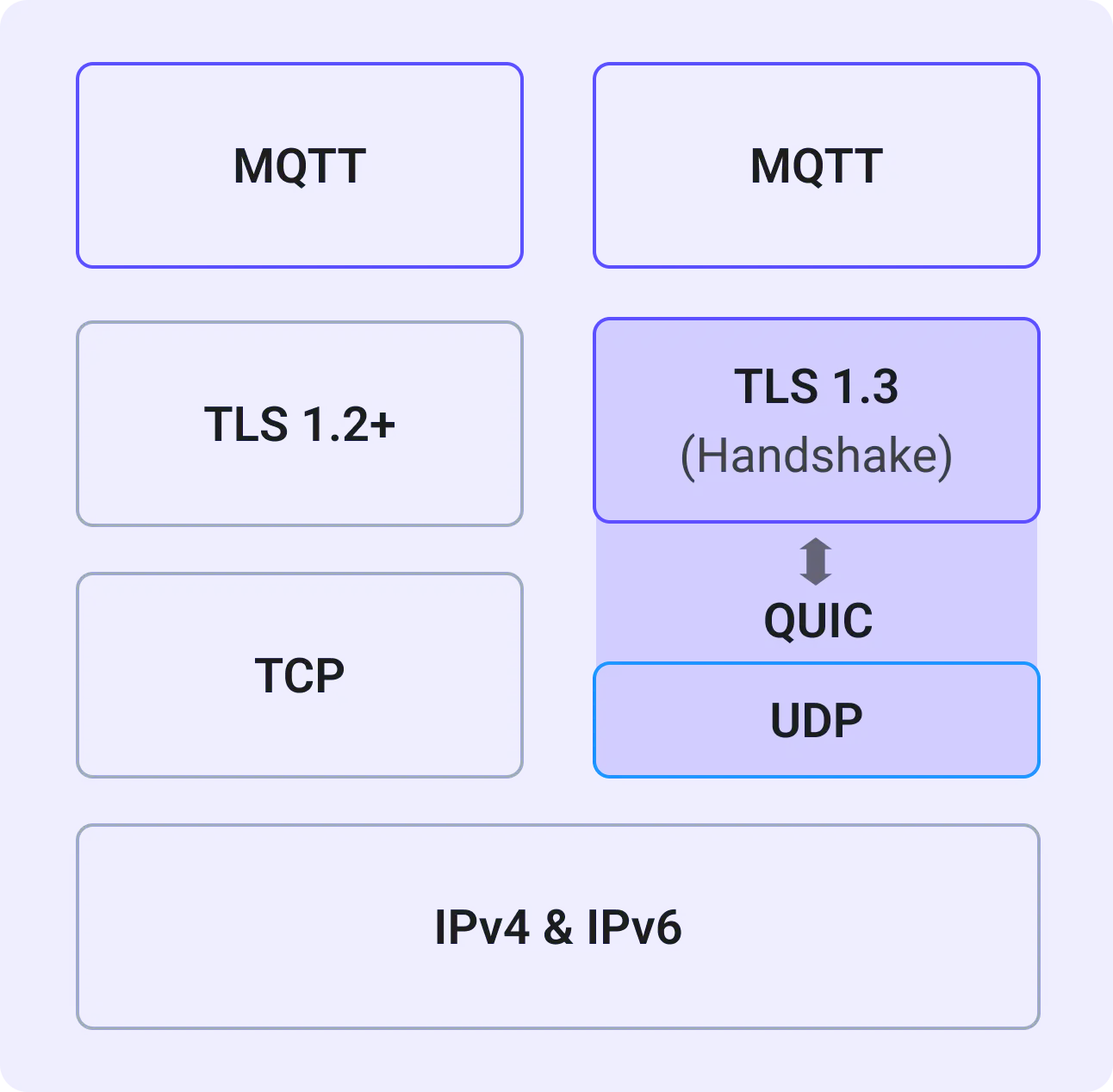
QUIC is specifically designed to solve the problems that TCP, designed for stable, wired connections, cannot. By running over UDP, QUIC resolves TCP's most significant bottlenecks, ushering in the next generation of IoV connectivity.
The 5 Ways QUIC Empowers Connected Cars
MQTT over QUIC transforms connectivity by providing distinct, measurable advantages crucial for mobile vehicles:
1. Immediate Connectivity via 0-RTT Resumption
In the IoV, fast reconnection is essential. When a vehicle exits a tunnel or leaves a garage, it must re-establish its cloud link instantly.
- The Problem: Traditional TCP/TLS requires multiple round trips (RTTs) for a full handshake, creating unacceptable delays every time a connection is restored.
- The QUIC Solution: QUIC's 0-RTT Resumption feature allows a connection to be resumed instantly using cached security parameters.
- IoV Value: Application data can be sent immediately upon initiation, ensuring critical services like remote lock/unlock commands or emergency services are available without delay. This dramatically improves the responsiveness and user experience of every connected car service.
2. Seamless Handoff with Address Mobility
A moving car is constantly switching cellular base stations, making it a nightmare for traditional TCP connections.
- The Problem: TCP connections are tied to the underlying IP address and port. Any change (e.g., switching from 4G to 5G, or getting a new IP address) results in connection termination and a full, slow re-establishment process.
- The QUIC Solution: QUIC connections are identified by a unique Connection ID, not the network tuple. This inherent Address Mobility means the logical connection remains active even if the vehicle's IP address changes.
- IoV Value: Telemetry, in-car entertainment streams, and large OTA update downloads are never interrupted during network handoffs. This ensures a true "always-on" experience, crucial for reliable data logging and uninterrupted customer services.
3. Eliminating Head-of-Line Blocking
Packet loss is a reality in mobile networks, especially in congested urban environments.
- The Problem: If a single packet is lost in a TCP connection, it blocks the delivery of all subsequent data on that connection until the lost packet is recovered. This is the Head-of-Line (HoL) Blocking issue.
- The QUIC Solution: QUIC mitigates HoL Blocking through Multiplexed Streams. Each data stream (e.g., one for ADAS data, one for vehicle diagnostics) operates independently, and loss recovery is isolated to the affected stream.
- IoV Value: High-priority, time-sensitive data (like safety alerts) can bypass any block caused by a lost packet in a low-priority stream (like bulky log files), significantly enhancing the real-time reliability of the most critical IoV services.
4. Unified Connection Management and Data Prioritization
IoV solutions typically run multiple distinct applications, often requiring separate connections.
- The Problem: Establishing multiple independent TCP/TLS connections for different applications (e.g., remote diagnostics, streaming media, V2X) consumes excess bandwidth, system resources, and battery life.
- The QUIC Solution: QUIC supports Connection Multiplexing, hosting multiple independent application streams within a single connection. It also allows for dynamic Data Prioritization & Flow Control based on application requirements. Furthermore, if a particular application stream encounters an error, only that stream is affected, providing robust Error Isolation.
- IoV Value: Optimizes the use of limited mobile bandwidth by prioritizing mission-critical data while streamlining the connection management overhead. This centralized, resilient approach enhances overall system efficiency and reliability.
5. Error Isolation and Stream Resilience
In complex vehicular systems, application or device errors are inevitable.
- The Problem: In traditional systems, an application-layer error or failure in one data flow might corrupt or disrupt the entire underlying TCP connection, affecting all running applications on that link.
- The QUIC Solution: MQTT over QUIC is designed with inherent Tolerance to Application Errors. Errors within one application stream (e.g., a diagnostic tool failure) do not adversely affect other concurrent streams (e.g., core telemetry data).
- IoV Value: The protocol provides for streamlined Error Recovery Mechanisms. If an issue occurs, the affected stream can be restarted or isolated without needing to sever or reset the entire connection. This results in minimal downtime and ensures continuous data flow for all other unaffected vehicle functions.
EMQX: Leading the MQTT over QUIC Revolution
EMQX was the first large-scale distributed MQTT Broker to fully support MQTT over QUIC. This leadership means that the EMQX team has been optimizing and hardening the QUIC implementation in real-world production environments for years. When you choose EMQX, you are choosing a solution with proven stability and performance at the core of your IoV architecture.
EMQX addresses enterprise-grade IoV needs with:
- Massive Scalability: EMQX's distributed architecture is designed to handle millions of concurrent vehicle connections, seamlessly integrating with QUIC's efficient connection model.
- Seamless Interoperability: EMQX provides unified support for both traditional MQTT over TCP/TLS and the newer MQTT over QUIC. This allows enterprises to smoothly transition their IoV fleet or maintain a hybrid deployment as their applications evolve.
- Unmatched Reliability: EMQX ensures your QUIC-enabled connections are backed by industry-leading high availability, fault tolerance, and global deployment capabilities—the essential foundation for mission-critical services.
Conclusion
MQTT over QUIC is not just an incremental upgrade; it is a fundamental shift in how connected cars communicate. It provides the faster, more reliable, and more resilient transport mechanism required for the next generation of IoV services, including advanced autonomous driving and complex V2X interactions.
The future of connected mobility demands a transport protocol built for speed and reliability. Try EMQX now to explore the benefits of MQTT over QUIC and build a network ready for millions of mobile devices.