Millions of Agents at Risk: The BadHost Vulnerability and Its Architectural Implications

Last week, Ars Technica reported that "millions of AI agents and tools around the world have been imperiled by a critical vulnerability that can allow hackers to breach the servers running them and make off with sensitive data and credentials to third-party accounts." The bug is real, and you should patch it today. What makes it striking is the scale: a single flaw in a single Python library exposed that many agent deployments at once. That is a consequence of how AI agents are deployed today, and the deployment model does not have to look this way.
The Bug
Researchers at X41 D-Sec disclosed CVE-2026-48710, "BadHost": Starlette before 1.0.1 derives request.url from the HTTP Host header without sanitizing it. The Host header is attacker-controlled, so injecting a character like /, ?, or # shifts where the path boundary falls in the reconstructed URL. The value that authorization middleware inspects, request.url.path, stops matching the path the router actually dispatches. Point the auth check at a permitted path while the router serves a protected one, and a request that should return 403 Forbidden returns 200 OK. One path gets authorized; another gets served. The bug bites apps that make an authorization decision from request.url; checks that read the ASGI scope path directly are not exposed the same way.
Starlette is downloaded around 325 million times a week and sits under FastAPI, so the blast radius is most of the Python AI tooling ecosystem: vLLM (where the bug was found, during an OSTIF-sponsored audit), LiteLLM, Text Generation Inference, OpenAI-compatible proxies, MCP servers, and agent frameworks including Google ADK, CrewAI, Langflow, and Dify. Severity depends on who scored it: the GitHub advisory rates it 6.5 (CVSS 3.1, Moderate), while X41 D-Sec scores it 7.0 (CVSS 4.0, High) and calls the real-world impact critical. The fix is Starlette 1.0.1, released 21 May 2026. If you run any of these, patch it.
Patching closes this hole. The reason a single flaw reached so many agents at once lies in the architecture of how those agents are deployed.
Why One Bug Reached Millions of Agents
X41's scan catalogued what sat behind the vulnerable servers: clinical-trial databases, live PII and KYB pipelines, SSH into industrial devices through a bastion, full mailbox read/send/delete, S3 export, security asset inventories. Every one of those is a credential an MCP server keeps so it can do its job, sitting one bypass away from the network.
A common way to ship these tools and agents is as remote HTTP services: an MCP server is a FastAPI app on a port, and an agent harness is another FastAPI app on a port. (MCP also runs locally over stdio, which this bug never touches; the exposure is the networked HTTP deployments.) Each network-reachable one stores long-lived credentials to the systems it bridges and runs the same ASGI ingress library underneath.
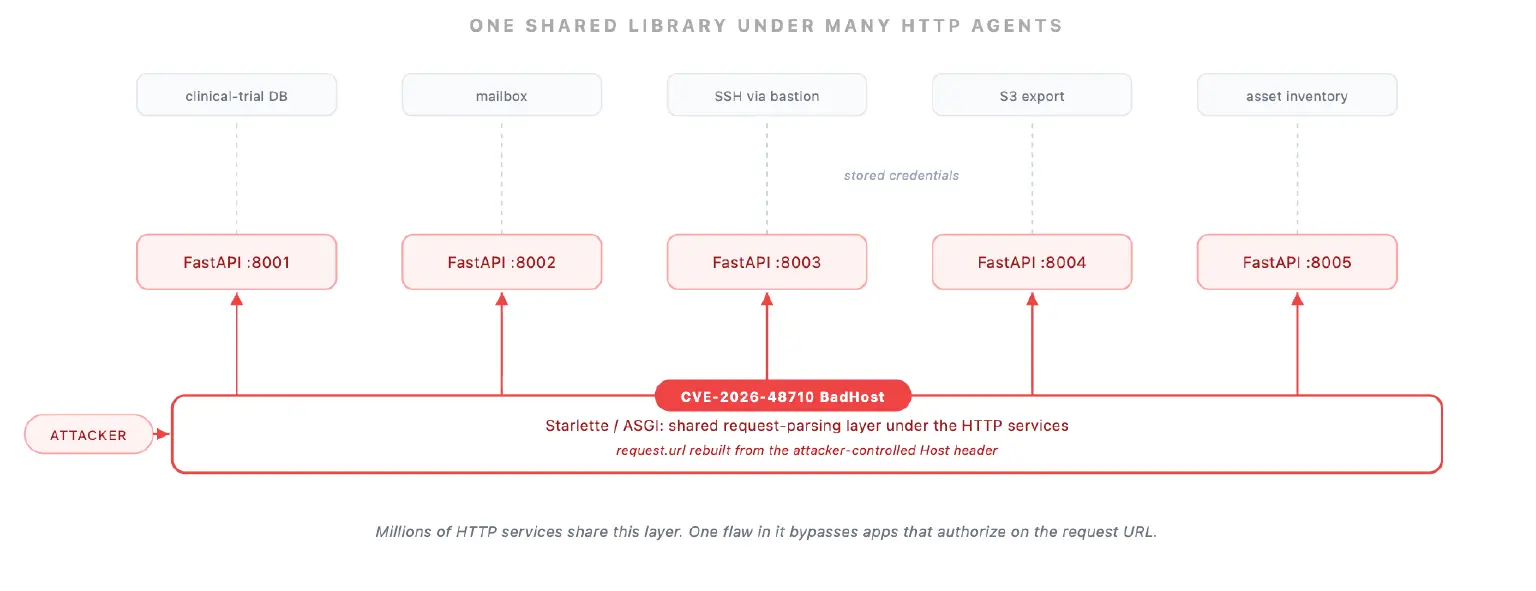
A flaw in that shared library is therefore a fleet-wide authorization bypass: one Host-header bug against a pattern repeated a few million times. "Behind a properly configured firewall" was the only thing between it and the data, and at the scale of one listener per tool, very little of that fleet is configured by anyone in particular.
The Threat Model of HTTP-Native Agents
The default stack's attack surface:
- An inbound listener per agent and per tool.
- URL-path-based routing and URL-path-based authorization, evaluated separately. This is the exact pairing that BadHost desynchronized.
- Implicit trust in the
Hostheader and the reconstructed URL. - Authorization middleware written and configured independently in each service.
- A discovery surface (well-known agent-card URLs) that is also scannable.
- Credentials sitting at the reachable endpoint, one bypass away from SSRF or RCE.
A broker-based transport takes away the inbound listeners that most of these depend on.
What Changes When the Transport is a Broker
MCP and A2A both have MQTT bindings: MCP-over-MQTT for agent-to-tool calls and A2A-over-MQTT for agent-to-agent coordination. Both are open specifications with reference SDKs. The architectural difference that matters for security is one sentence: agents and tools stop being servers.
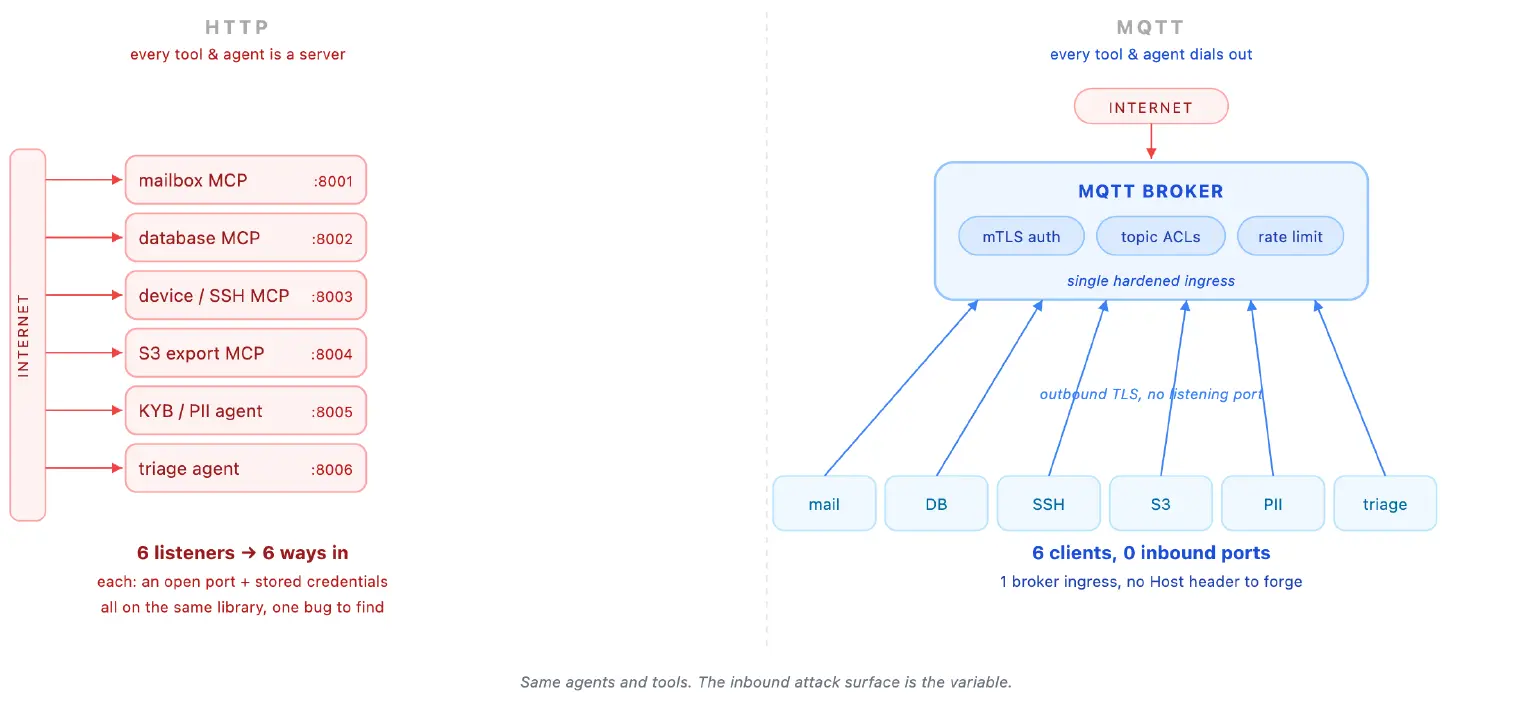
In the MQTT binding, an MCP server is an MQTT client, not an HTTP listener. It opens an outbound TLS connection to a broker and subscribes to its own request topic. The same is true of an A2A agent. Nothing listens for inbound HTTP on the tool or the agent. Concretely:
- No inbound listener to reach. You cannot send a crafted request to an MCP server that has no open port. The set of network-reachable endpoints collapses from "every tool and every agent" to "the broker." Run 50 agents and 200 tools and you go from 250 internet- or LAN-reachable servers to one broker.
- The BadHost class is not expressible. MQTT routes on topic names, not on a URL rebuilt from a
Hostheader. There is noHostheader, no URL reconstruction, norequest.url.path, and no gap between the path that was routed and the path that was authorized. You cannot have a Host-header authorization bypass in a protocol that has no Host header. - Transport authorization is centralized. mTLS certificates or broker credentials authenticate the client when the connection opens, and the broker then checks every publish and subscribe against topic ACLs bound to that identity. The A2A-over-MQTT profile scopes each client to topics under its own
{org_id}/{unit_id}/{agent_id}. This is the part that replaces the per-service ingress middleware BadHost bypassed. - Application authorization stays separate. The transport does not authorize the task. The A2A profile carries an OAuth bearer token in a per-request
a2a-authorizationproperty, and the responding agent validates the token, scopes, and tool permissions before acting. BadHost happened because one URL-path check was doing both jobs; keeping transport and application authorization apart is the point. - Discovery can move off public HTTP. Agent Cards can be retained messages under
$a2a/v1/discovery/..., gated by the same ACLs, instead of well-known HTTP URLs an attacker can crawl. The A2A spec still permits HTTP well-known discovery for interoperability, so this only holds if you run discovery MQTT-only and ACL-gated.
The net effect is fewer places to attack from outside. Instead of a few million inbound HTTP front doors, each with its own configuration and its own copy of the vulnerable library, the only thing listening is the broker: one ingress built to be exposed, hardened and patched in one place, rate-limited, and monitored.
Map it Back to the BadHost Exposure List
Take the categories from X41's exposure list and ask what BadHost's specific entry point looks like in the brokered model:
- Email/SaaS mailbox access: the mail tool is an outbound broker client, so there is no inbound listener for a forged Host header to bypass and the credential store is not internet-reachable. An authenticated request over the broker can still ask the tool to read mail, which is why the responder has to check scopes.
- IoT/Industrial SSH through a bastion: device tools already connect outbound to a broker, so there is no per-device HTTP server for this bug to reach.
- Biopharma databases via SSRF: an SSRF that depended on inbound routing confusion has no inbound routing left to confuse.
BadHost's entry point was a reachable HTTP listener that trusted a header. Remove the listener and that entry point is gone. What is left is application-level authorization, and that still has to hold up.
What This Does Not Fix
A security post that stops there is marketing. The honest limits:
- The broker is now the high-value target. You have concentrated the attack surface, not deleted it. A broker CVE, an auth or ACL bypass, or a compromised admin is systemic in a way a single leaky FastAPI server was not. This is the same bet you make with an API gateway or a reverse proxy: one ingress built and staffed to be exposed beats a few hundred that were not. It is still a bet.
- An authenticated peer can still reach the tool. Removing the inbound listener stops outsiders from reaching the tool directly. It does nothing about a compromised agent, a stolen MQTT credential, or an over-broad ACL: any of those can publish a valid request on the tool's topic, and the tool acts on it if its own authorization allows. The broker changes who can reach the tool, not whether the tool checks what it is asked to do.
- The broker sees your payloads unless you stop it. Topic ACLs gate who can publish and subscribe; they do not hide message contents from the broker itself. If the broker must not see or alter payloads, you need end-to-end encryption. The A2A-over-MQTT spec defines an untrusted-broker profile (
ubsp-v1) that JWE-encrypts request and reply payloads and adds replay protection, which is the right tool when the broker sits outside your trust boundary. - One ingress is also one thing to knock over. Concentrating all agent traffic on the broker makes its availability a single point of failure, and the discovery namespace can be flooded when a large fleet reconnects. The many-listeners model spreads that load out. Cluster the broker, rate-limit it, and cap registration size.
- MQTT-over-WebSocket puts an HTTP listener back. If you expose the broker's WebSocket port, the upgrade handshake is HTTP again. It is one listener in the broker's hardened code path, still gated by broker auth and ACLs after the upgrade, but it is HTTP. Configure it deliberately.
- Tools still hold secrets and still call outward. Moving an MCP server off a public listener removes the inbound attack surface. It does not remove the API key, and it does not stop the tool from making a server-side request to the third-party API it fronts. Brokered transport closes the inbound-ingress class of bug, not all credential risk.
- Model-serving endpoints are a separate problem. vLLM and LiteLLM are HTTP inference servers in their own right. The broker argument is about agent and tool coordination, not the model server, which you still secure the usual way.
- ACLs are only as good as you write them. The broker enforces topic permissions; it does not invent least-privilege topic design. Over-broad wildcards on request or reply topics reintroduce lateral movement between agents. A compromised identity does whatever its ACLs allow.
- This is an architecture, not a product. MCP-over-MQTT and A2A-over-MQTT are open specs plus reference SDKs; the A2A profile is still marked draft and broker-neutral. The broker-native piece shipping today is the A2A Registry in EMQX 6.2, which adds schema validation, status tracking, and registration rate and size limits. Nobody is shipping a turnkey secure-agent product. The security comes from the transport shape, and you can adopt it on any MQTT v5 broker.
What to Do
If you run HTTP MCP servers today: upgrade Starlette to 1.0.1, scan your fleet with the BadHost scanner (only against systems you are authorized to test) to catch anything you missed, get those servers off public listeners and behind a gateway that validates the Host header, and have any auth middleware read scope["path"] instead of the reconstructed request.url.path.
If you are designing agent and tool communication now, prefer a transport where agents and tools connect outbound to a broker rather than each listening for inbound requests. That leaves you one ingress to defend instead of many, transport authorization enforced in one place against authenticated identities, and discovery kept off the public network. Application authorization still lives in the agents, where it belongs. The MQTT bindings are one way to get there, and they were built for many-to-many messaging across unreliable links, which is the case HTTP request-response handles poorly.
Starlette 1.0.1 fixes BadHost. It leaves untouched the deployment pattern that turned one parser bug into a fleet-wide event: every agent running its own HTTP server that trusts a header and holds live credentials. Changing that pattern, rather than patching the next library underneath it, is the longer-term fix.