Connecting Smart Loading Dock Equipment Across Thousands of Warehouse Locations with MQTT Architecture

Executive Summary
A leading warehouse equipment OEM producing connected dock and warehouse equipment needed to unify thousands of IoT gateways deployed across customer facilities to a centralized management platform. The company used EMQX Enterprise for the 10x growth plan and strict SOC2/ISO-27001 compliance requirements. EMQX's Kubernetes-native architecture, compliance-ready deployment patterns, and native cloud data bridging capabilities enabled rapid scaling while maintaining enterprise security posture.
Smart Warehouses: The Shift to Connected Loading Dock Systems
Warehouse and logistics operations are undergoing digital transformation as companies implement connected loading dock systems: automated doors, levelers, safety barriers, and environmental controls. Connected dock equipment enables:
- Real-time facility monitoring: Track door cycles, equipment faults, and maintenance needs across dozens or hundreds of locations
- Predictive maintenance: Identify wear patterns before failures occur, reducing unplanned downtime
- Safety compliance: Automated logging of safety barrier engagement, safety interlocks, and emergency events
- Operations optimization: Analyze dock utilization, peak times, and efficiency metrics across the facility network
However, deploying IoT connectivity across thousands of geographically distributed customer facilities introduces operational complexity: device diversity, inconsistent network conditions, compliance requirements, and the need for local autonomy (facilities continue operating if WAN connectivity fails).
The Challenge: Massive Geographic Distribution and Strict Compliance
The industrial equipment manufacturer faced several interconnected challenges as they moved from connected device prototypes to production-scale deployments:
- Massive Distribution with Local Autonomy: Customers operate multiple gateways and downstream devices per site. A single customer might have devices across 50 different facilities. If the connection from a remote location to cloud failed, dock operations couldn't stop. Local safety interlocks and emergency controls must function autonomously.
- Proprietary Protocol Bridging: Dock controllers used the company's proprietary control protocol. The IoT platform needed to bridge from proprietary devices (via local gateway) to standardized cloud protocols.
- Compliance & Security: The company's customers (large retailers, logistics operators, automotive plants) required SOC2 Type 2 and ISO-27001 certification. The IoT platform needed to support auditability, encryption, access controls, and compliance logging from day one.
- Kubernetes-Native Operations: The company standardized on enterprise-grade managed Kubernetes for new services. The MQTT broker needed to deploy natively on Kubernetes without requiring custom operational tooling or extensive configuration.
- Gradual Scaling with Cost Control: The infrastructure needed to grow incrementally without requiring major rearchitecture. Each new customer or facility addition should require minimal operational overhead.
- Multi-Environment Management: Production and development clusters needed identical configurations and deployment patterns to ensure consistency and enable disaster recovery testing.
Why MQTT for Warehouse IoT Gateway Architecture
MQTT emerged as the ideal protocol for this distributed gateway architecture:
- Gateway Aggregation Pattern: Individual gateways aggregate local devices, reducing cloud connection count and improving WAN bandwidth efficiency. MQTT's pub-sub model maps naturally to this topology.
- Local Autonomy with Cloud Sync: Gateways can operate autonomously during cloud outages (publishing locally and caching configurations), triggering automatic synchronization via MQTT persistent sessions upon reconnection.
- Standard Protocol Removes Vendor Lock-in: Rather than a proprietary gateway-to-cloud protocol, MQTT enables customers to integrate gateways with third-party systems (analytics platforms, facility management systems, ERP systems) without custom integrations.
- Lightweight Edge Footprint: MQTT's low resource footprint leaves critical processor cycles free on gateway hardware for real-time local control and safety logic.
- Proven Industrial Reliability: MQTT's simple, battle-tested design provides robust data transmission across poor or fluctuating remote network conditions.
EMQX Solution Architecture on Kubernetes
The equipment manufacturer deployed EMQX Enterprise on Kubernetes with the following architecture:
- Multi-Zone Kubernetes Deployment: Deployed a 3-node production EMQX cluster across multiple availability zones using the EMQX Operator for automated scaling, alongside a mirrored development cluster for disaster recovery.
- Secure Gateway Connectivity: Gateways connect via TLS 1.3+ to a cloud-hosted load balancer using client certificates (X.509 mTLS) for hardware identity verification.
- Streamlined Data Flow Pipeline:
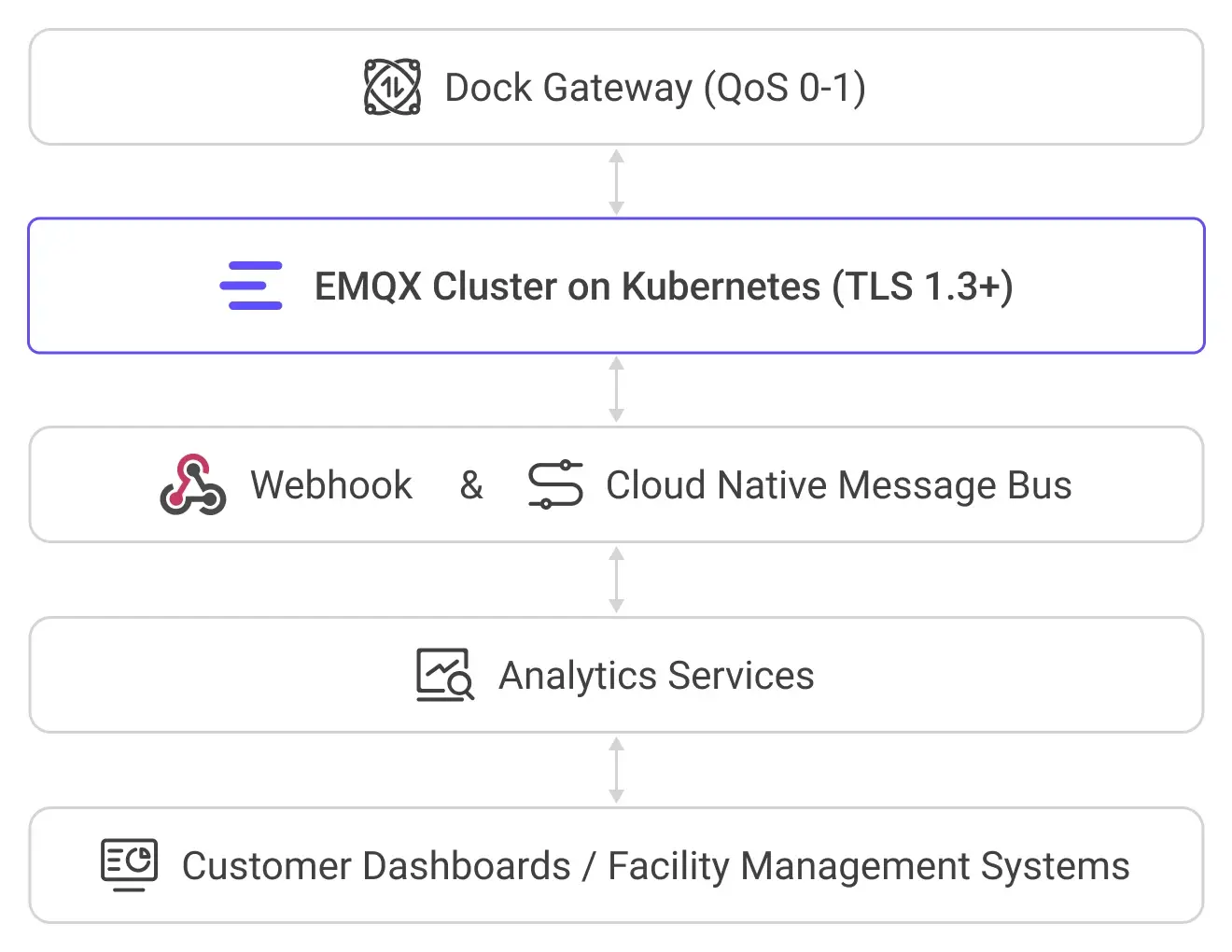
- Granular Multi-Topic Architecture: Structured paths manage distinct data types, separating real-time telemetry (
telemetry), cloud-to-gateway commands (command), and gateway health status (status). - Compliance-Focused Audit Logging: Captures all MQTT connections (timestamps, client cert CNs, IPs) and enforces topic-level ACLs, paired with a configurable retention for command/audit events.
- Active-Passive Disaster Recovery: Automated daily backups from production to development clusters combined with Kubernetes' multi-zone distribution ensure seamless failover and zero message loss.
Key EMQX Capabilities Deployed
- Kubernetes-Native Deployment via EMQX Operator: Eliminates custom deployment tooling. EMQX Operator automates scaling, rolling updates, and health management within standard Kubernetes patterns.
- Native Enterprise Cloud Data Bridge: Built-in data bridges enable seamless, native connectivity to enterprise cloud messaging and streaming data systems, feeding directly into cloud data warehouses, time-series databases, and cold storage pipelines without requiring custom webhook infrastructure.
- TLS 1.3 & mTLS Client Certificates: Industry-standard encryption and authentication with certificate pinning support. Each gateway certificate includes facility metadata (location ID, device type) for audit traceability.
- Topic-Level Access Control with Audit Logging: Fine-grained ACLs and compliance logging support SOC2 Type 2 and ISO-27001 requirements without custom application code.
- QoS 0 & 1 Optimization: Gateways use QoS 0 for telemetry (fire-and-forget, acceptable for sensor data) and QoS 1 for critical commands (at-least-once delivery). EMQX optimizes both efficiently.
- Horizontal Scaling on Kubernetes: New gateways or growing message volume automatically trigger Kubernetes node scaling; EMQX cluster adds capacity seamlessly without operational intervention.
Results & Value Delivered
- Rapid Production Deployment: The Kubernetes-native architecture allowed operational teams to deploy the production environment in weeks rather than months with minimal training.
- Compliance Readiness: Built-in audit logging and topic ACLs satisfied SOC2 Type 2 and ISO-27001 auditors on first review. No custom compliance layers required.
- Transparent Scaling: Infrastructure scales purely through automated Kubernetes resource adjustments, requiring zero application changes, protocol redesigns, or customer-facing disruptions.
- Edge Autonomy with Cloud Benefits: Facilities maintain 100% operational uptime (local automation and safety interlocks continue) during WAN outages, while still leveraging centralized cloud updates when online.
- Reduced Total Cost of Ownership: Leveraging a local-first gateway architecture reduces continuous cloud dependency and expensive WAN data egress costs.
- Operational Simplicity: Native Kubernetes platform integration eliminated custom operational tooling for operations teams.
Conclusion
EMQX's enterprise-grade Kubernetes integration, native cloud data bridges, and compliance-ready audit logging enabled this industrial equipment OEM to rapidly scale from prototype to global production while fully satisfying strict security mandates. The platform's proven ability to handle low-throughput, high-connection scenarios across geographically distributed networks makes it the ideal blueprint for enterprise industrial IoT deployments spanning thousands of remote customer locations.