Building the Nervous System for Physical AI: Key Takeaways from CES 2026

CES 2026 has marked a historic pivot in the evolution of artificial intelligence. The industry has moved decisively beyond digital-only models, ushering in the era of Physical AI. As showcased across the halls of Las Vegas, intelligence is no longer confined to screens; it is being embodied in humanoids, software-defined vehicles, and autonomous agents that interact dynamically with the physical world.
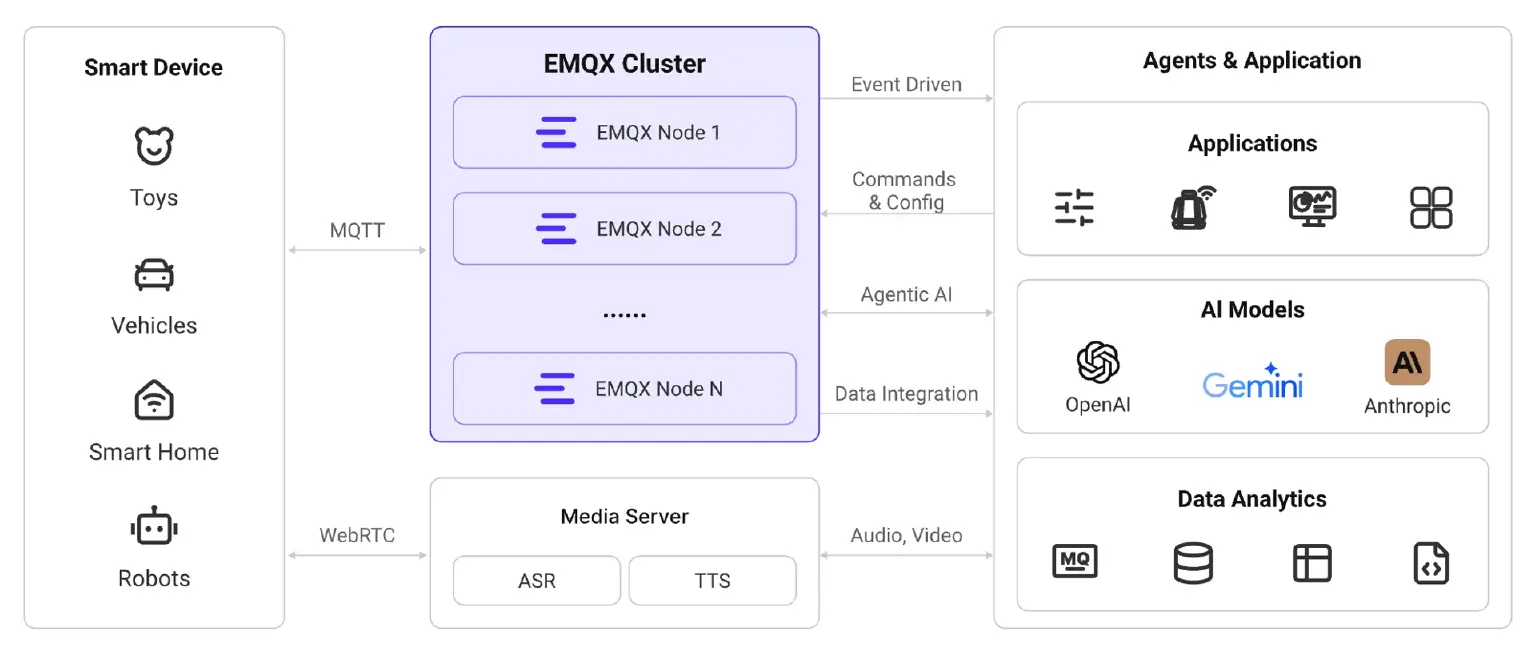
For this transition to succeed, the industry is realizing that a sophisticated "brain" requires a resilient "nervous system." As Physical AI breaks out into production, MQTT has emerged as the definitive protocol for bridging the physical-digital divide, with EMQX serving as the central backbone of this burgeoning ecosystem.
Physical AI: Why Event-Driven Messaging Matters
Physical AI systems, from robots to industrial machines, operate very differently from traditional software applications. They are not request-driven or transactional by nature. Instead, they depend on continuous streams of telemetry, sensor updates, and state changes that must be delivered reliably and in real time.
While low-level control loops often utilize protocols like DDS or ROS 2 for microsecond-level intra-device communication, MQTT acts as the "Macro-Nervous System." Its publish/subscribe model allows physical systems to emit events as they happen, while downstream consumers(e.g., AI models, control systems, digital twins) subscribe to the data they need without tight coupling. Features such as persistent sessions, quality-of-service(QoS), and bi-directional communication make MQTT well-suited for environments where connectivity may fluctuate but reliability cannot.
EMQX builds on these strengths, providing a production-grade unified MQTT platform that handles massive concurrency and stateful sessions, ensuring that AI remains responsive and resilient across unstable networks.
Learn more: The AI-Ready MQTT Platform for Real-Time IoT Data
Edge Intelligence: Coordinating AI Across Device and Cloud
Not all intelligence can, or should, live in the cloud. AI workloads are increasingly distributed across devices, gateways, and cloud platforms to meet latency, cost, and reliability requirements. This hybrid reality requires a unified data fabric to prevent fragmentation.
EMQX addresses this through a seamless, scalable edge-to-cloud architecture that combines the industrial connectivity gateway (EMQX Neuron) and the high-performance edge MQTT broker (EMQX Edge). Organizations can deploy MQTT-native processing locally—filtering and routing critical data—while maintaining a high-speed uplink to the cloud. This enables true collaboration between localized physical actions and global AI insights.
Learn more: The Unified MQTT Platform for Edge Computing
Software-Defined Vehicles: Physical AI in Motion
Software-Defined Vehicles (SDVs) represent one of the most mature and demanding Physical AI environments. Modern vehicles are effectively distributed computing systems, generating continuous streams of data across in-vehicle networks and vehicle-to-cloud channels.
EMQX plays a central role by providing a Unified In-Vehicle & V2X Communications Architecture. Rather than just a transport layer, EMQX serves as the real-time messaging backbone that orchestrates the data loop between the vehicle's onboard systems and the cloud.
This architecture is already proven at scale, powering over one million electric vehicles from Geely, Zeekr, and Lynk & Co. It enables the continuous data feedback loop required for autonomous driving model training and real-time feature evolution, meeting the stringent reliability standards of vehicles in motion.
Learn more: The Unified MQTT Platform for Software-Defined Vehicles
Smart Hardware: Connecting Devices, Media, and AI
CES 2026 also highlighted a new generation of smart hardware that combines sensing, interaction, and AI-driven intelligence. These devices increasingly need to connect not only data streams, but also media, context, and AI reasoning.
In this space, EMQX is pioneering the integration of MCP (Model Context Protocol) with MQTT, effectively bridging the gap between AI model reasoning and real-time device control. By encapsulating MCP’s standardized tool-calling within MQTT’s lightweight transport, EMQX enables a unified architecture where LLMs can query and command physical hardware with unprecedented interoperability.
Learn more:
The Nervous System the Physical AI Requires
CES 2026 revealed a consistent architectural requirement of the Physical AI era: a real-time, event-driven infrastructure that is scalable, reliable, and designed for the seamless, bi-directional flow of intelligence. To act, feel, and learn, Physical AI needs more than just storage or a data layer; it needs a living connection to its environment.
EMQX is the Nervous System for Physical AI. By providing a platform that ensures end-to-end security, low-latency distribution, and seamless protocol orchestration, EMQX acts as the vital pathway through which intelligence moves. As we enter this future of embodied autonomy, EMQX stands as the foundational nervous system upon which the next generation of intelligent physical systems will be built, scaled, and brought to life.