Cross-Region MQTT Cluster Linking for Global Physical Access Control Systems

Executive Summary
To expand from regional deployments to a global platform, a leading physical security solutions provider delivering cloud-based access control and camera management systems deployed EMQX Enterprise across a multi-region architecture spanning the United States and EMEA. By leveraging Cluster Linking, the solution enables seamless cross-region event routing with sub-500 ms latency and QoS 2 reliability, ensuring every access control event is delivered exactly once.
This unified MQTT backbone eliminates the need for complex custom replication, allowing thousands of customer sites to connect to the nearest data center while maintaining a centralized, audit-grade record of all security events.
The Shift to Cloud-Native Physical Security SaaS
Physical security is transitioning from isolated, on-premises systems to cloud-native, multi-tenant SaaS platforms. Organizations operating globally, with offices, warehouses, and facilities across continents, require centralized access control, audit logging, and real-time event notification across all sites.
Modern access control platforms must support:
- Real-time event delivery: Door unlock/lock commands, access denials, intrusion alerts
- Multi-tenant isolation: Separate customer data and events; enforcing strict access boundaries
- Global low-latency performance: Users and cameras anywhere should report events sub-second
- Audit-grade reliability: Every access event must be recorded with QoS 2 guarantees (no loss, no duplication)
- Legacy device integration: Support for RFID readers and door controllers, and on-premises systems via webhooks and APIs
The Challenge
A global physical security solutions provider faces a unique challenge: how to build a global infrastructure that feels local.
Cross-Region Message Delivery
Subscribers in one region need to receive events published in another. For example, a security officer logged into the EMEA cluster must be notified when access is denied at a North American facility. Traditional regional MQTT deployments require clients to connect to every region or events to be replicated via external services. Both approaches introduce latency, cost, or operational complexity.
Latency-Sensitive Security Events
Access denials and intrusion alerts must propagate globally with minimal latency. Queuing delays or asynchronous replication introduce unacceptable lag in security responses. A client connecting to the nearest datacenter should receive events sub-second, whether or not they originate in that region.
Guaranteed Delivery at Scale
Every door unlock, access grant, and alert must be logged without loss or duplication, even if clusters fail or clients disconnect temporarily.
Multi-Datacenter Operations
Operating three independent MQTT clusters without a native broker-linking mechanism forces customers to build custom replication logic: SNS/SQS subscriptions, Kafka bridges, or manual topic synchronization. This increases operational burden and introduces consistency risks.
Cost Efficiency in Multi-Region Deployments
Cross-region data transfer charges accumulate quickly if events are forwarded via external message queues. A solution that minimizes inter-cluster traffic without sacrificing reliability reduces both cost and operational complexity.
Why MQTT?
MQTT emerged as the ideal protocol for this use case:
Real-Time Event Delivery
MQTT's publish-subscribe pattern decouples event publishers (access control gateways) from subscribers (web dashboards, mobile apps, logging systems). Events propagate instantly without polling or callback overhead.
Lightweight Protocol
MQTT's small header overhead (2-4 bytes) and binary payload support minimize bandwidth per event, critical for cost-sensitive multi-region deployments serving thousands of concurrent devices and users.
QoS 2 Exactly-Once Semantics
MQTT QoS 2 implements a two-phase commit-like protocol, ensuring no message loss and no duplication even if brokers or clients crash mid-transmission. This satisfies audit and compliance requirements for access control.
Message Persistence and Durable Sessions
MQTT brokers can persist offline client subscriptions and buffer messages. When a client reconnects, it automatically receives missed events, critical for mobile apps and offline-capable devices.
Lightweight Device Support
Traditional access control hardware (RFID readers, door controllers) can publish events via MQTT with minimal CPU and memory overhead, enabling cost-effective device integration.
The EMQX Solution: Orchestrating Cross-Region Physical Security
Multi-Region Cluster Architecture
The organization deployed EMQX Enterprise in three geographically distributed clusters:
| Region | Datacenter | Connections (Phase 1) | Cluster Linking |
|---|---|---|---|
| US (Primary) | US East | ~5,000 | Linked to both US West & EMEA via cluster link |
| US (Secondary) | US West | ~5,000 | Linked to both US East & EMEA |
| EMEA | EU Central | ~5,000 | Linked to both US West and East |
Latency-Based Client Routing
- Geographic Load Balancing: DNS returns the nearest cluster IP based on client geolocation
- Client Connection: Devices and applications connect to their local cluster (e.g., European users → EMEA cluster)
- Cross-Region Event Delivery: Cluster Linking enables MQTT message routing between clusters; a subscriber in EMEA automatically receives events published in the US
Event Flow Architecture
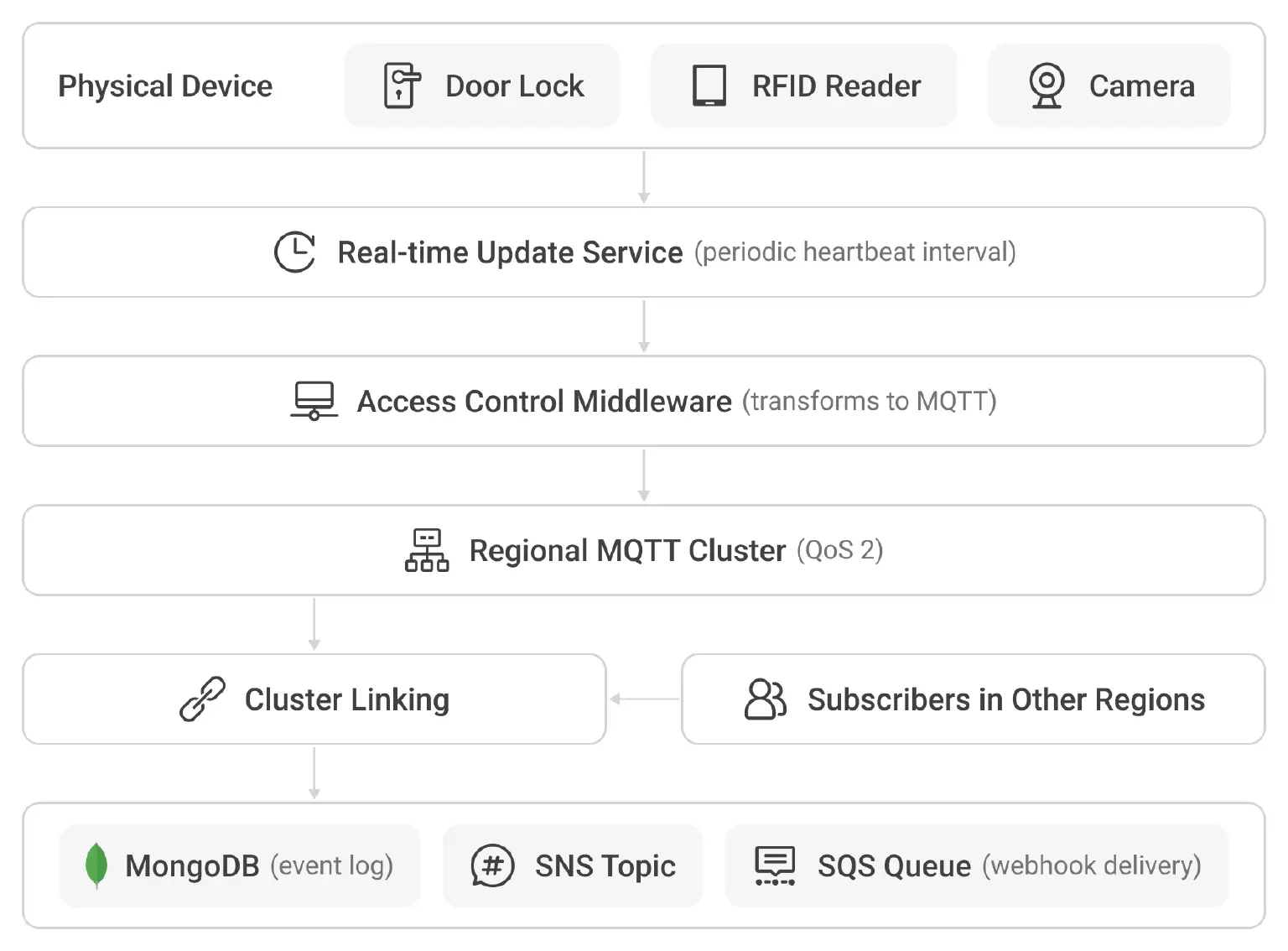
Key Integration Points
Real-time Update and Access Control Middleware
Legacy access control systems publish events via a custom middleware layer to the local MQTT cluster. The middleware handles protocol translation from native access control APIs to MQTT Sparkplug or standard JSON payloads.
MongoDB Persistence
All events are persisted to both cloud and local MongoDB instances via EMQX rules engine. This provides long-term audit logs and enables historical queries (e.g., "all access denied events in the last 30 days").
AWS SNS/SQS Integration
Customer-facing webhooks and third-party integrations (Slack alerts, security monitoring services, SIEM systems) subscribe to SNS topics published from MQTT events. EMQX rules bridge MQTT → SNS → SQS for reliable async event distribution.
Legacy Client and Unified Client API Layer
Legacy cloud application and modern mobile apps interface via the unified client API gateway, which subscribes to MQTT topics and translates to REST/gRPC. This decouples app development from MQTT changes.
Multi-Tier Non-Production Environments
- Development Cluster: Isolated EMQX cluster for feature validation and performance testing
- Test Cluster: Replicates production topology (three-region), used for integration testing before deployment
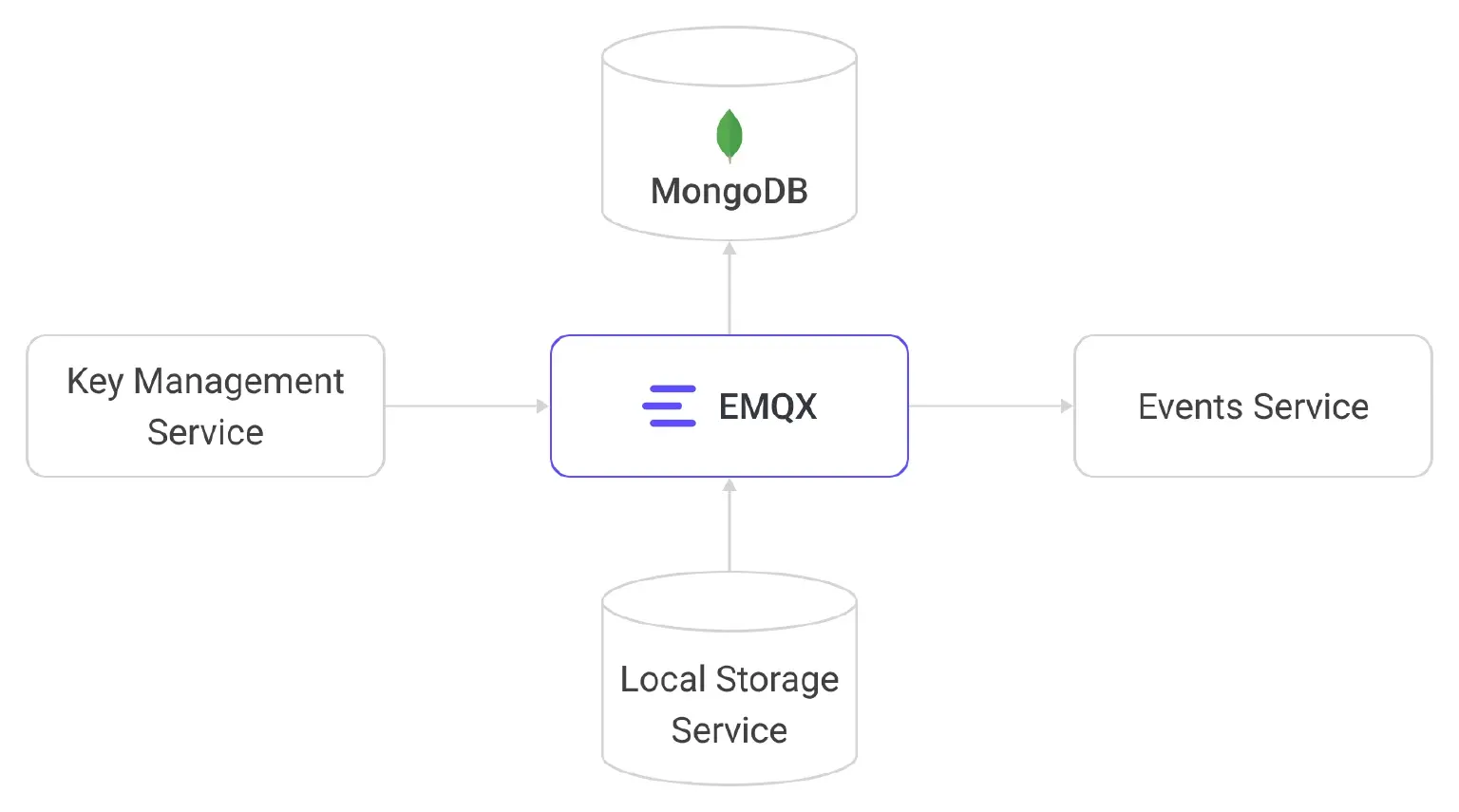
Key EMQX Capabilities Enabling the Solution
Cluster Linking
EMQX Enterprise's broker-to-broker Cluster Linking feature enables bi-directional message routing between independent clusters. A topic published in one region is automatically replicated to subscribers in all linked regions, eliminating the need for external message queues or custom replication logic. Cluster Linking preserves QoS 2 guarantees across region boundaries.
Multi-Region High Availability
Each region operates an independent cluster with internal replication (HA) and external cluster linking. Failure of one region does not affect the others; subscribers in surviving regions continue receiving events via cluster links.
QoS 2 Reliability at Scale
EMQX's optimized QoS 2 implementation maintains exactly-once delivery semantics across all regional clusters with headroom for 10x growth.
Rules Engine and Data Bridges
Pre-built connectors to MongoDB (event storage) and AWS SNS (webhook distribution) eliminate custom code. EMQX rules filter and route events based on topic patterns (e.g., "route all /access/denied/* events to MongoDB and SNS").
Session Persistence
EMQX stores session state for mobile and web clients, enabling automatic reconnection and missed message replay when clients come online after temporary network loss.
Webhook Integration
Native webhook publishing allows EMQX to send HTTP POST events to third-party systems (Slack, Azure Monitor, customer logging services) without requiring external ETL tools.
Enterprise Support and Managed Services
24/7 support and operational guidance ensure reliable multi-region deployments and SLA compliance.
Results and Value Delivered
Successful POC Validation
Completed trial POC confirmed latency, load, and publish/subscribe performance met production requirements. No platform changes were needed after POC completion: EMQX was production-ready on day one.
Simplified Multi-Region Operations
Cluster Linking eliminated the need to build custom message replication logic. Operators maintain three independent clusters with automatic cross-region event flow, reducing operational complexity and human error.
Sub-Second Latency Globally
Latency-based routing ensures clients connect to the nearest datacenter; typical latency for access control events is <500 ms globally. Cross-region subscribers receive events via cluster links within seconds, suitable for security officer dashboards and audit systems.
Compliance-Grade Audit Logging
QoS 2 guarantees and MongoDB persistence ensure every access event is recorded exactly once, with full timestamp and metadata. Regulatory audits and incident investigations have a complete, tamper-proof event log.
Cost Efficiency
Cluster Linking reduces inter-region replication costs compared to SNS/SQS-based replication. Event delivery stays within the EMQX cluster network, minimizing AWS egress charges.
Vendor Lock-In Avoidance
Built on open standards (MQTT) allows the organization to migrate clients or integrate new third-party systems with minimal friction. The platform is not dependent on AWS-only services for core functionality.
Rapid Rollout to Customers
The platform launched as a new global offering, supporting immediate scaling to thousands of customer sites. New customers onboard in the nearest region without infrastructure changes.
Conclusion
By deploying EMQX Enterprise with Cluster Linking, this global physical security provider built a truly global access control platform. Cross-region broker linking enables subscribers anywhere to receive events published anywhere else, with automatic latency-based routing and QoS 2 reliability. The combination of MQTT's real-time semantics and EMQX's multi-region capabilities eliminated the need for complex external replication logic, reducing time-to-market and operational burden. The solution serves as the foundation for a new generation of cloud-native security systems that scale globally without compromise.