Distributed Edge MQTT Architecture for Intelligent Building Management Across Global Facilities

Executive Summary
A global building technology and industrial automation leader architected a distributed edge computing platform using EMQX Edge to aggregate sensor and equipment data from thousands of buildings worldwide. By deploying lightweight MQTT brokers at each facility, the organization created a scalable foundation for real-time building optimization, predictive maintenance, and AI-driven analytics.
Industry Context
Modern building management systems have evolved beyond HVAC scheduling and energy monitoring into intelligent platforms that optimize occupant comfort, operational efficiency, and sustainability. Smart buildings integrate hundreds of sensors (temperature, occupancy, air quality, equipment telemetry) with controllers, automation systems, and predictive analytics engines.
As buildings become "smart," centralized cloud platforms struggle with network latency, bandwidth constraints, and resilience requirements. This triggers a shift toward distributed edge computing architectures where local intelligence processes real-time sensor data, with aggregated insights flowing to central cloud systems for cross-facility analytics and AI-driven optimization.
The Challenge: Scaling Edge Intelligence Across Global Facilities
The organization operates a geographically dispersed portfolio of buildings requiring:
- Distributed processing at the edge: Each facility (building, plant, campus) requires a local message broker to aggregate sensor and controller data, enabling immediate automation decisions without cloud round-trips
- Massive sensor integration: 40–50 simultaneous connections per facility (sensors, PLCs, controllers, gateways) generating 800K–1M messages per second across all active devices at a single site
- Container-native infrastructure: Deployment in containerized environments (Docker, Kubernetes) aligned with modern infrastructure practices and CI/CD pipelines
- Scalable data persistence: Integration with backend databases (PostgreSQL) for time-series data, historical analysis, and cross-facility trend identification
- Future bridging capability: Potential for edge-to-edge cluster linking across geographically proximate facilities and eventual integration with central cloud aggregation systems
- Operational simplicity: Standardized edge broker deployments across 25+ initial production sites with plans to scale to 100+ in the future
Why MQTT for Distributed Building Automation
MQTT emerged as the standard for building automation and industrial IoT for several compelling reasons:
- Lightweight protocol: Binary messaging and minimal overhead allow thousands of sensors to communicate efficiently over facility networks, including older building infrastructures with constrained bandwidth
- Publish-subscribe topology: Natural fit for building automation's broadcast patterns (e.g., central HVAC controller publishes setpoint changes; thermostats and sensors subscribe to updates)
- Reliable message delivery: QoS levels ensure critical equipment commands (fire suppression, emergency systems) reach destinations reliably, while non-critical telemetry (ambient temperature trends) tolerates best-effort delivery
- Edge-to-cloud continuity: MQTT bridges seamlessly from edge brokers (facility-level aggregation) to cloud systems (cross-facility analytics) without protocol translation or middleware
- Industrial protocol support: Via gateways and industrial adapters, MQTT integrates legacy equipment (Modbus, OPC-UA sensors/controllers) into modern automation architectures
EMQX Edge Solution Architecture for Smart Buildings
EMQX Edge is a high-performance, ultra-lightweight MQTT broker specifically engineered for the IoT edge. It serves as a local data hub that aggregates information from devices, processes data in real-time, and reliably bridges critical information to cloud platforms or central enterprise systems.
Learn more: EMQX Edge Datasheet: Lightweight UNS MQTT Broker for IoT Edge
The organization deployed EMQX Edge at each facility location in a distributed edge computing pattern.
Deployment Model:
- One broker per facility: Each building, plant, or campus operates an independent EMQX Edge instance managing local sensors, controllers, and automation logic
- Phased Fleet Rollout: The initial production deployment covers the first wave of core facilities, with a roadmap to scale across the entire global facility network within the next fiscal year.
- Containerized delivery: Docker-based deployment enables consistent provisioning, scaling, and orchestration across diverse facility IT environments
Per-Facility Scale:
- Device Aggregation: Each local broker efficiently multiplexes concurrent connections from varied OT hardware, including environmental sensors, PLCs, edge gateways, and building controllers.
- High-Throughput Processing: The architecture handles massive message-per-second spikes per broker during peak operational periods, ensuring real-time responsiveness for safety and automation logic.
- Flexible Payload Accommodation: Built-in support for large binary and JSON payloads comfortably accommodates dense sensor array telemetry and comprehensive controller status data.
- Isolated Non-Production Environments: Dedicated test and staging brokers are maintained for safe feature validation, firmware updates, and continuous disaster recovery drills.
Data Integration Architecture:
EMQX Edge's PostgreSQL data bridge persists facility-level aggregated data:
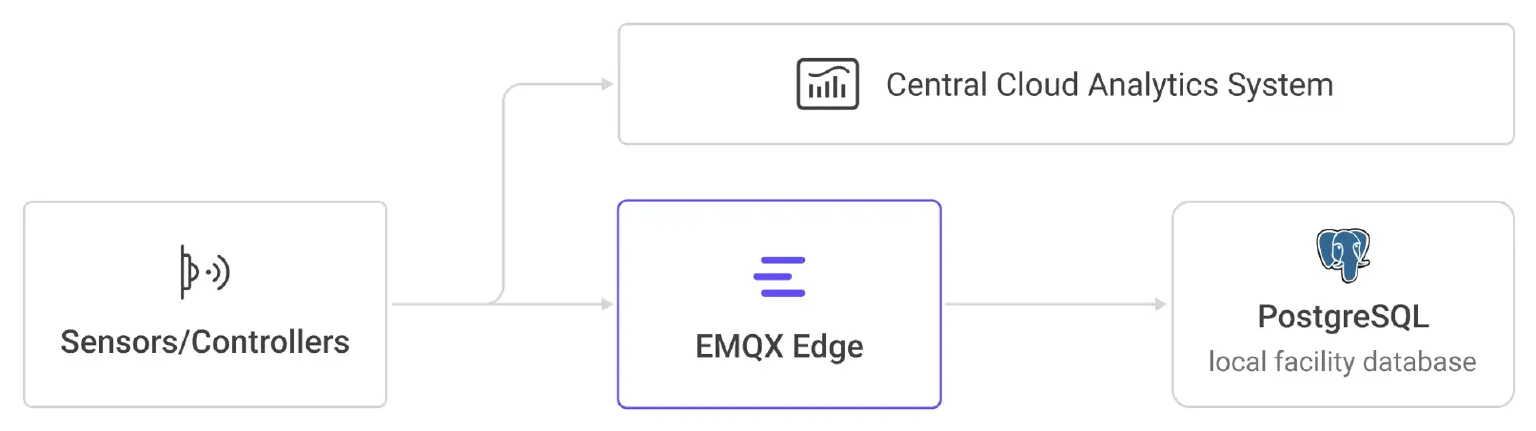
This pattern enables:
- Real-time local automation: MQTT rules process sensor data and trigger local controller responses within milliseconds
- Time-series storage: PostgreSQL buffers facility telemetry for local analytics, trending, and regulatory compliance audits
- Cloud synchronization: Aggregated summaries (hourly facility metrics) flow to central systems for cross-facility AI/ML analysis without overwhelming network bandwidth with raw sensor streams
Topic Architecture:
building/{facility-id}/floor/{level}/sensor/{type}/{id}/data
building/{facility-id}/hvac/controller/setpoint/command
building/{facility-id}/security/alert/{zone-id}
building/{facility-id}/energy/meter/{type}
Key EMQX Capabilities Deployed
- EMQX Edge lightweight broker: Minimal resource footprint suitable for containerized facility-level deployments, with full MQTT 5.0 compliance
- High-throughput ingestion: 800K–1M msg/sec per broker handles sensor bursts during peak facility operations (occupancy changes, emergency events)
- PostgreSQL data bridge: Real-time persistence of facility data with built-in buffering for offline scenarios
- Containerized deployment: Docker images with standardized configuration enable rapid provisioning across diverse facility IT environments
- Session management: Persistent sessions for controllers and sensors reduce reconnection overhead and ensure message delivery after transient network interruptions
- SQL-like rule engine: Facility-level automation rules (threshold-based alerts, state-based HVAC commands) execute at the edge without cloud latency
- Future cluster linking: Bridging capability for edge-to-edge communication across proximate facilities and eventual cloud aggregation
Business Value
The deployment of EMQX Edge transformed the organization’s building management into a highly resilient, cost-efficient distributed network.
- Rapid Enterprise Scaling: Successfully validates a high-throughput architecture across initial production sites, cutting new facility onboarding time from months to weeks and providing a blueprint for a multi-fold global expansion.
- Edge Intelligence & Cloud Offloading: Enables sub-second localized automation (such as HVAC adjustments and fault detection) while filtering raw telemetry at the edge, drastically reducing cloud bandwidth consumption and data egress costs.
- Fault Isolation & Continuity: Ensures facility-level operational continuity during cloud outages, completely isolating local disruptions to prevent network-wide cascading downtime.
- Infrastructure Cost Reduction: Minimizes local hardware footprint through ultra-lightweight edge brokers and eliminates redundant cloud API calls by shifting automation logic away from the cloud backend.
- Future-Ready Interoperability: Unifies diverse environmental sensors, PLCs, and controllers under a standardized MQTT foundation, paving the way for hybrid cloud-edge analytics and cross-facility predictive maintenance.
Conclusion
EMQX Edge enabled this global building technology leader to architect a distributed, scalable edge computing platform for intelligent building management. By deploying lightweight MQTT brokers at facility locations, the organization achieved real-time sensor aggregation, local automation intelligence, and efficient data integration with central analytics systems. As the platform expands globally, EMQX's containerized, high-throughput design provides the operational foundation for next-generation building intelligence across thousands of facilities worldwide.