Enterprise MQTT Infrastructure for Connected Medical Device Fleets in Clinical Environments

Executive Summary
A leading connected healthcare technology company managing smart medical devices across thousands of clinical sites undertook a strategic platform consolidation to replace legacy open-source MQTT and AMQP brokers with an enterprise-grade messaging infrastructure. Facing scaling requirements from 100,000 current devices to 500,000–1,000,000 over the next 3–5 years, the organization required mission-critical reliability, QoS 2 support for life-critical data, on-premise deployment flexibility, and multi-protocol capabilities. EMQX Enterprise emerged as the foundation for a unified, secure medical device communication platform designed to meet stringent healthcare regulatory requirements while enabling real-time clinical data workflows.
Industry Context
Connected healthcare has transformed from isolated point-of-care devices into interconnected clinical ecosystems where smart infusion pumps, patient monitors, nurse call systems, and electronic health records communicate in real-time. Clinical staff depend on these networks for medication delivery, patient safety monitoring, and operational coordination.
Unlike consumer IoT, medical device IoT faces unique constraints:
- Life-critical reliability: failures can impact patient outcomes
- Regulatory compliance: FDA, HIPAA, international medical device standards
- Heterogeneous legacy and modern equipment
- Demanding uptime SLAs
Healthcare organizations increasingly architect centralized medical device platforms to enable clinical intelligence, predictive maintenance, and interoperability across device manufacturers, requiring messaging infrastructure engineered specifically for healthcare's reliability and regulatory rigor.
The Challenge: Scaling Mission-Critical Medical Device Connectivity
The organization operates a growing connected healthcare platform serving clinical sites worldwide, facing:
- Mission-critical reliability: Medical device communication failures directly impact patient safety; systems must maintain 99.99%+ uptime with no tolerance for data loss on life-critical messages.
- Massive scale at high reliability: Current fleet of 100,000 devices with planned growth to 500,000–1,000,000 over 3–5 years; each 10x growth increment demands infrastructure re-architecting without service interruptions.
- Life-critical QoS requirements: Smart infusion pumps delivering medication, patient monitoring systems tracking vital signs, and emergency alerts require guaranteed delivery (QoS 2) with no possibility of message loss or duplication.
- Multi-protocol legacy support: Existing infrastructure uses both MQTT and AMQP; platform consolidation must support both protocols without application refactoring.
- On-premise regulatory mandate: Healthcare data residency and compliance requirements mandate on-premise deployment (no managed cloud); infrastructure must run within customer-controlled environments.
- Microservices integration: Modern clinical analytics, alerting, and interoperability services consume MQTT/AMQP events; broker must enable polyglot consumption patterns.
- Enterprise operations standards: Healthcare IT departments require comprehensive monitoring, audit trails, access controls, and disaster recovery capabilities typically unavailable in open-source software.
Why MQTT for Medical Device Communication
MQTT provides an ideal foundation for connected medical device ecosystems:
- Lightweight efficiency: Medical devices range from resource-constrained wearables and bedside monitors to server-grade infusion pump controllers; MQTT's minimal overhead accommodates this spectrum without modification
- Reliable delivery: QoS 2 ensures medication infusion commands and critical alerts reach their destinations exactly once, essential when duplicate infusions or missed alerts can harm patients
- Session persistence: Devices maintain state across network interruptions; bedside monitors reconnecting after temporary disconnect resume patient monitoring without care team intervention
- Topic-based routing: Naturally expresses clinical workflows (e.g.,
hospital/icu/bed-15/vital-signsfor specific patient monitoring;pharmacy/infusion/batch-alertsfor pharmacy alerts), enabling role-based access and clinical workflows - Proven medical device ecosystem: MQTT has become the standard protocol for connected medical devices; manufacturers across infusion pumps, monitors, and clinical systems support native MQTT integration
The EMQX Solution: Real-Time Messaging for Mission-Critical Healthcare Workflows
The organization deployed EMQX Enterprise as the unified platform for medical device connectivity.
Deployment Model:
- On-premise infrastructure: EMQX Enterprise running in customer-controlled environments, meeting healthcare data residency and compliance requirements.
- High availability architecture: Clustered EMQX nodes across multiple availability zones, ensuring 99.99%+ uptime and automatic failover without clinical team intervention.
- Unified protocol support: MQTT 5.0 for modern medical devices; AMQP bridge for legacy healthcare systems; transparent protocol translation at the broker layer.
Scale & Performance Targets:
- Capacity: 100,000 concurrent connected medical devices; plan to scale to 1,000,000+ within 5 years
- Throughput: 10,000s of events per second across the fleet (vital signs, infusion status, alerts, clinical notifications)
- Message patterns:
- High-frequency: Vital sign streams from patient monitors (10–60 Hz per bed)
- Critical: Infusion pump medication commands and safety alerts (QoS 2 guaranteed delivery)
- Low-frequency: Device telemetry, maintenance alerts, clinical notifications
Security & Access Control:
EMQX Enterprise's fine-grained authentication and ACL framework enforces healthcare role-based access:
RN (Nurse Role): Subscribe to vital-signs/*, infusion-alerts/*
Pharmacist Role: Subscribe to pharmacy/infusion/*, medication/alerts/*
ICU_Team Role: Publish to equipment/alerts/icu-*, subscribe to patient/*/vital-signs
Device: Publish to its specific topic only (device/serial-12345/*)
QoS Architecture:
- QoS 2 (guaranteed delivery): Medication infusion commands, critical safety alerts, emergency notifications
- QoS 1 (at-least-once): Device telemetry, status updates, routine clinical messages
- QoS 0 (best-effort): Non-critical device heartbeats, performance metrics
- Message buffering: Persistent session storage ensures no loss of QoS 1/2 messages during brief network interruptions or device reconnection
Data Integration & Microservices:
EMQX's rule engine and data bridges enable real-time clinical workflows:
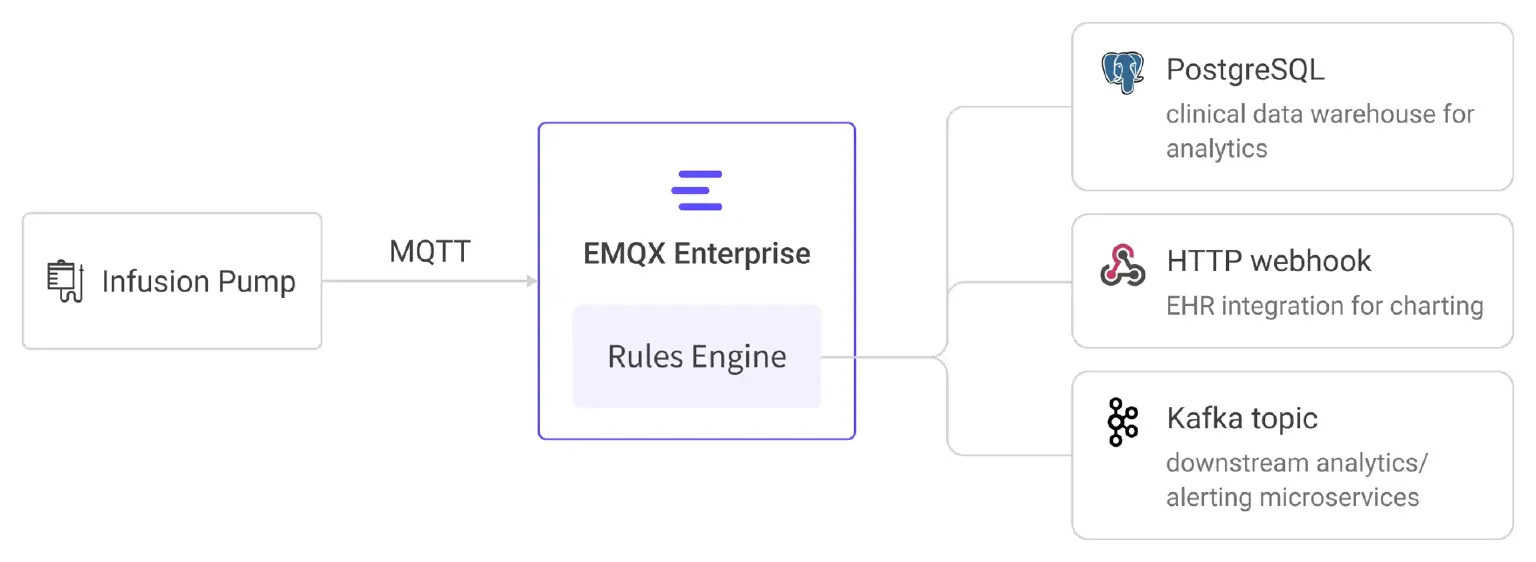
This pattern enables:
- Real-time clinical alerts: Infusion pump errors or patient vital sign anomalies trigger immediate care team notifications
- Compliance audit trails: All device communication logged for regulatory audits (FDA, HIPAA)
- Clinical analytics: De-identified aggregated device data feeds predictive maintenance, usage optimization, and clinical outcome studies
High Availability & Disaster Recovery:
- Multi-node clustering with automatic leader election ensures broker failover within seconds
- Message persistence guarantees no loss during node failures
- Geographic replication enables recovery from facility-level disasters
Key EMQX Capabilities Deployed
- Enterprise-grade reliability: 99.99%+ uptime SLA, built-in clustering, automatic failover, and persistent message storage
- QoS 2 support: Guaranteed exactly-once delivery for life-critical medical device commands and alerts
- Multi-protocol bridge: Simultaneous MQTT 5.0 and AMQP support eliminates application refactoring during platform migrations
- On-premise deployment: Runs entirely within customer data centers, meeting healthcare data residency regulations
- Fine-grained RBAC: Authentication and ACL enforce clinical role-based access to device data and commands
- Durable sessions: Device reconnection seamlessly resumes messaging without manual intervention
- Rule engine: Real-time message processing enables clinical logic execution at the broker (threshold-based alerts, device status aggregation)
- Data bridges: PostgreSQL, HTTP, and Kafka integrations connect medical device streams to clinical data warehouses, EHRs, and analytics platforms
- Comprehensive monitoring: Dashboards, metrics, and audit logging provide operational visibility required by healthcare IT
Business Value
Clinical Reliability & Patient Safety
- Mission-Critical Uptime: Achieved 99.99%+ availability with a local-first architecture that eliminates dependency on external cloud services for life-saving functions.
- Zero-Failure Messaging: Eliminated missed safety alerts and medication errors, ensuring continuous monitoring without manual intervention.
Regulatory Compliance & Security
- Data Sovereignty: On-premise deployment meets strict HIPAA, FDA, and international residency mandates by keeping patient data within customer-controlled environments.
- Zero-Trust Access: Robust RBAC and audit trails prevent unauthorized device commands, satisfying complex healthcare security audits.
Scalability & Operational Efficiency
- 100x Growth Readiness: A future-proof architecture designed to scale from 100k to 1M+ devices without application refactoring or increased management burden.
- Streamlined Operations: Unified MQTT/AMQP support and the built-in Rule Engine replace fragmented legacy brokers and custom middleware, slashing maintenance overhead.
Accelerated Time-to-Market
- Rapid Deployment: Leveraging a proven healthcare reference architecture enables a production rollout, significantly faster than custom-built alternatives.
- Interoperability: Native microservices and Kafka integration provide a foundation for next-generation clinical analytics and ecosystem standardization.
Conclusion
EMQX Enterprise provided a leading healthcare technology company with the enterprise-grade, mission-critical messaging infrastructure required to scale connected medical device platforms from 100,000 to 1,000,000+ devices. By supporting QoS 2 for life-critical data, on-premise deployment for regulatory compliance, multi-protocol integration for legacy compatibility, and fine-grained access controls for clinical roles, EMQX emerged as the operational backbone for real-time patient safety, clinical workflows, and healthcare IoT at scale.