Beyond Fixed Rules: AI-Agentic Residential Energy Storage with EMQ Device Agent

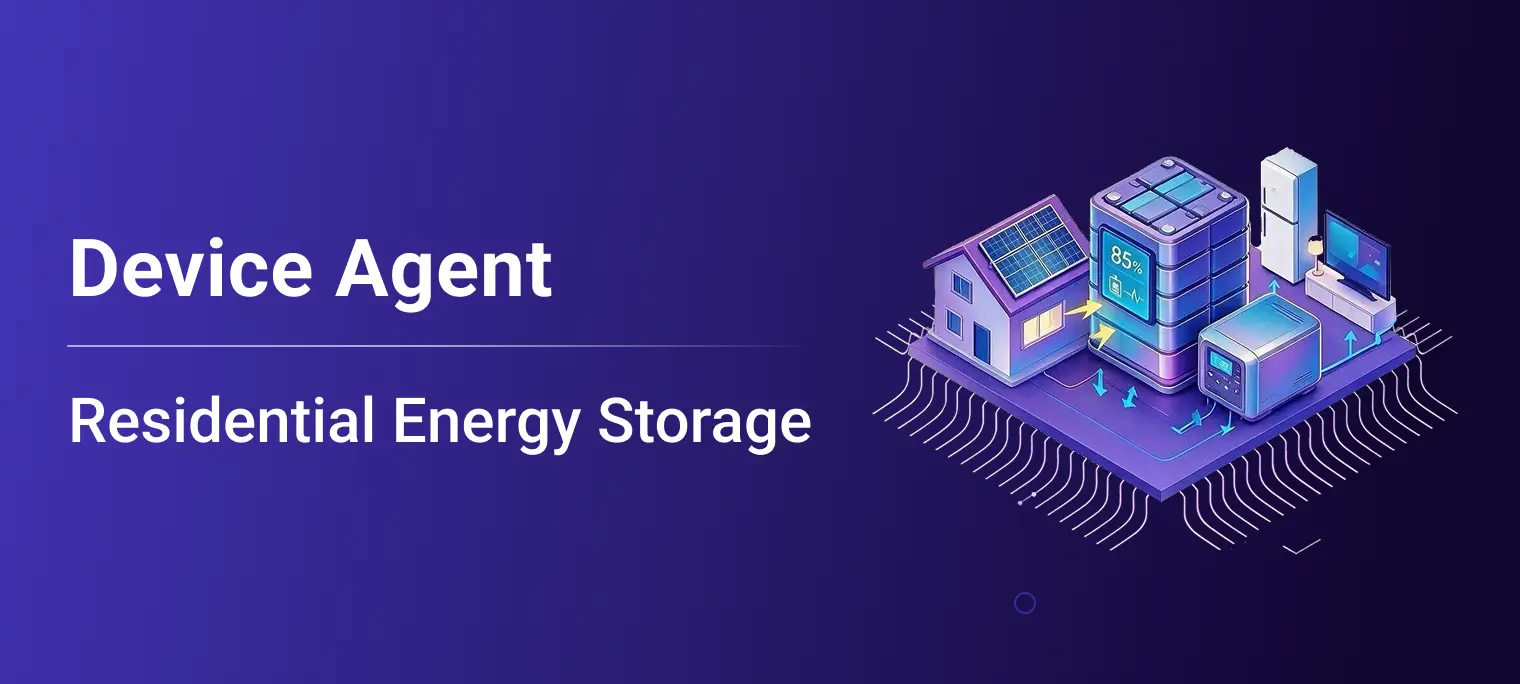
The Shift in Residential Energy Storage: From Hardware Specs to Software Intelligence
The competitive landscape for residential Energy Storage Systems (ESS) is undergoing a fundamental shift. Differences in raw hardware specifications, such as battery cell capacity, inverter efficiency, and thermal management, are rapidly narrowing across vendors. Instead, customer satisfaction and brand differentiation now pivot heavily on software capabilities: intelligent energy management, adaptive cost savings, and rapid feature iteration.
However, traditional residential ESS products face a critical operational dilemma: shortly after deployment, they degrade into glorified static timers. They charge and discharge on fixed schedules regardless of volatile electricity tariffs, sudden weather changes, or evolving household consumption habits. Users rarely have the time or technical expertise to manually reprogram these systems, leading to missed energy savings and diminished long-term product value.
The Cost of Static Firmware: March 2023 European Market Volatility Case Study
In March 2023, European power markets suffered intense spot-price fluctuations driven by declining gas prices, fluctuating renewable output, and variable demand across the Nord Pool, EPEX Spot DE, and EPEX Spot NL markets.
- Nordic Region (Nord Pool): Day-ahead prices soared to ~€130/MWh on March 6, before plummeting to ~€60/MWh on March 25 due to solar/wind surges, even turning negative during peak hours.
- Germany & Netherlands (EPEX Spot DE & NL): Similar trend with prices peaking above €120/MWh mid-month, then plunging to near €15/MWh within 10 days.
A rigid charging schedule configured on March 1 became entirely obsolete by mid-month. ESS users without dynamic, hourly recalculation capabilities failed to capture significant arbitrage margins, highlighting the urgent necessity for real-time, adaptive energy dispatch.
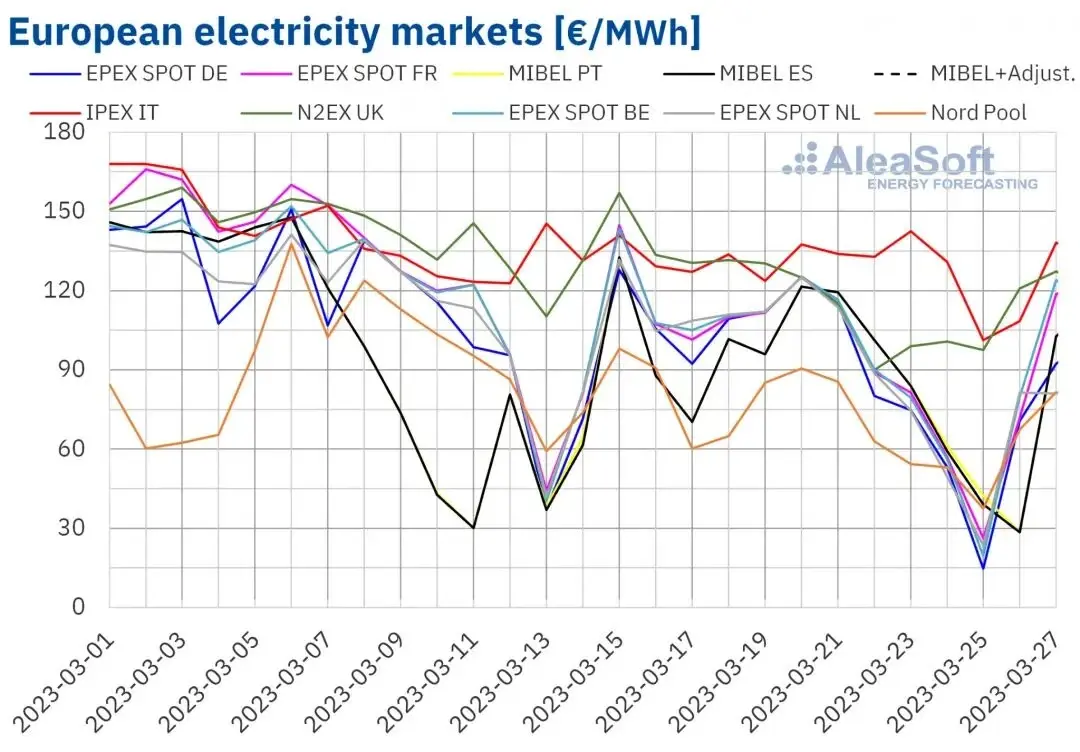
Source from: https://aleasoft.com
Key Structural Bottlenecks in Traditional ESS Architecture
The failure of current ESS systems to adapt dynamically is not caused by weak hardware engineering, but by an architectural flaw: locking perception and decision-making logic inside edge MCU firmware. This creates three critical bottlenecks:
Non-Intuitive, Rigid User Interaction
Existing mobile applications rely on rigid, multi-step navigational flows: Open App → Select Device → Manual Mode Override → Parameter Input → Confirm. This design assumes the user possesses explicit domain knowledge and clear operational targets.
In reality, user intent is contextual and narrative-driven.
For instance, a user stating, "I have guests visiting tomorrow afternoon, so power usage will be higher. Please adjust accordingly," expresses multi-layered intent: time constraints, load forecasting, and optimization requests.
Traditional rule engines cannot interpret natural language or infer contextual intent, resulting in high operational friction and elevated customer support costs.
Slow Firmware Iteration and High OTA Risk
New features must undergo a lengthy pipeline: Development → Testing → Firmware Flashing → Staged OTA Rollout → Full Deployment, with a single iteration cycle measuring in weeks or even months. Should an issue arise, rolling back the release requires repeating this entire grueling process.
Furthermore, integrating dynamic external data sources (e.g., local weather feeds or dynamic tariff APIs) requires embedding resource-heavy SDKs into edge firmware, bounded tightly by MCU memory and processing power.
Rigid Hardware BOM Cost Constraints
Running local AI inference engines or complex scheduling algorithms directly on edge devices demands higher-tier System-on-Chips (SoCs). This significantly inflates hardware Bill of Materials (BOM) costs, pricing the product out of competitive consumer markets.
EMQ Device Agent: Architecting Cloud-Native Intelligence
To break this structural bottleneck, EMQ decouples the intelligence and reasoning layer from physical device firmware. By shifting heavy inference, multi-modal contextual analysis, and algorithm orchestration to the cloud while keeping edge firmware lightweight and execution-focused, the system achieves cloud-native intelligence without raising edge hardware costs.
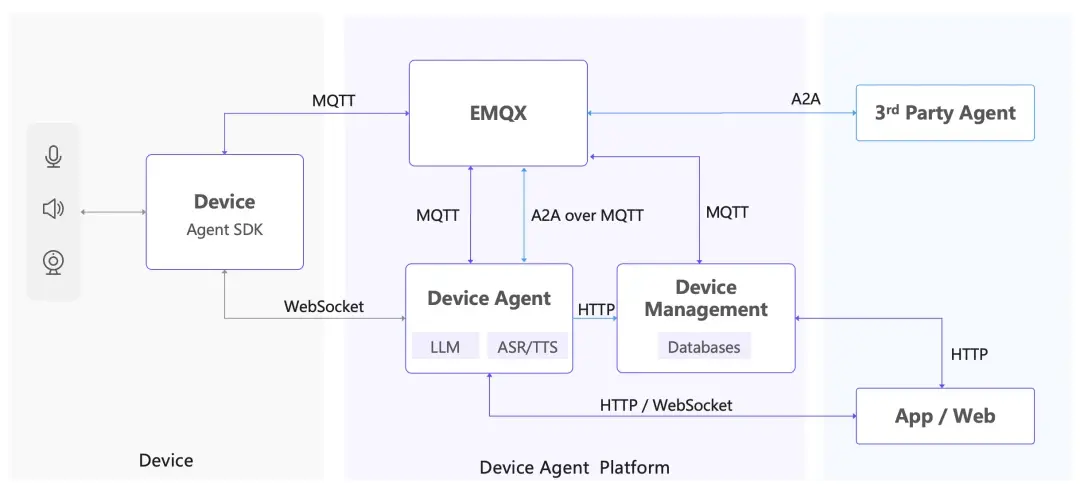
Core Architecture Components:
- Device Agent: Runs in the cloud. Handles perception, contextual understanding, and strategy generation. Powered by scalable cloud compute, models can be updated dynamically without firmware dependencies.
- Device Management: Maintains system context, spatial topology, device metadata, and historical telemetry data.
- EMQX MQTT Broker: Ingests telemetry/events and dispatches AI control commands. As the A2A (Agent-to-Agent) communication hub, it enables agent registry, discovery, and asynchronous messaging.
- Edge Device: Low-cost MCU executing simple operational instructions. Features minimal power consumption and voice connectivity over WebSocket.
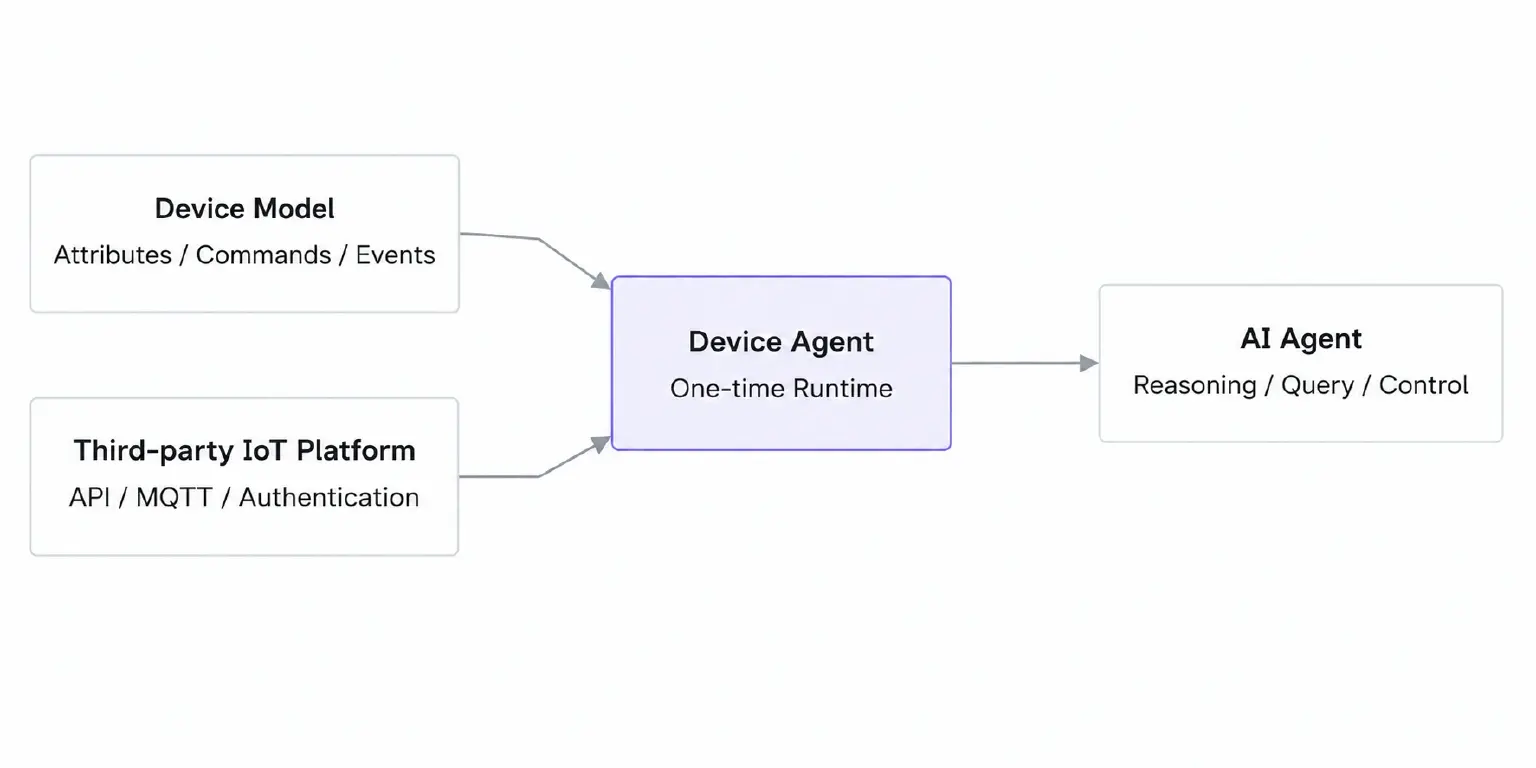
Crucially, Device Agent does not replace the existing IoT platform; it operates as a specialized intelligence layer directly above it. Through unified abstract device modeling, vendor-specific telemetry protocols and data structures are normalized into standardized interfaces. This decoupling ensures core scheduling strategies and custom skills can be seamlessly reused across diverse hardware brands, reducing ecosystem expansion and migration costs.
Core Capabilities and Technical Highlights
Natural Language Intent Processing
Instead of manual menu navigation, users express operational preferences via conversational dialogs. The agent executes a structured five-stage workflow:
Example Query: "I have guests visiting tomorrow afternoon, so power usage will be higher. Please adjust accordingly."
Device Agent Workflow:
- Intent Recognition: Identifies an energy schedule optimization request.
- Entity Extraction: Parses temporal window (tomorrow afternoon) and load modifier (+demand surge).
- Tool Orchestration: Invokes external APIs for weather forecasts, dynamic grid tariff rates, and BMS state-of-charge (SOC).
- Optimization Run: Computes the updated charging/discharging vector and dispatches control commands.
- Feedback Generation: Responds to the user with a concise summary of planned actions.
Modular Grid Scheduling & Flexible Strategy Tools
The scheduling algorithm is the core competitive advantage of home ESS products. Device Agent provides an orchestrable algorithm integration framework, compressing strategy iteration cycles from firmware release timelines down to simple code deployment.
The Device Agent workflow follows a Sense (Events) -> Reason (Agent) -> Act (Action Tools) pipeline, where every link is plug-and-play:
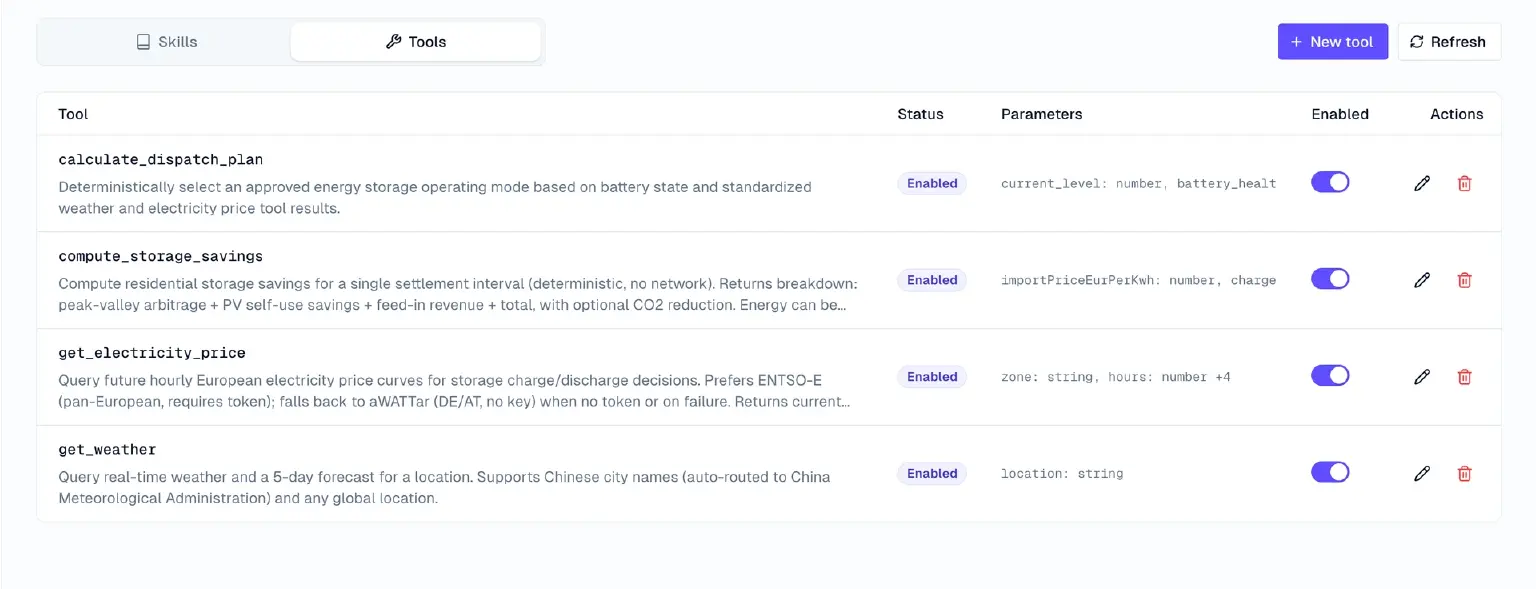
- New Tariff Models: Simply add a tool API and register it to the Agent tool list.
- New Scheduling Strategies: Write a skill script and deploy it live instantly.
This entire process requires zero modification to edge firmware. Product designers can quickly create and update various data sources and smart scheduling algorithms via the custom skills and tools management console provided by Device Agent.
Data Source Tools
In European residential storage scenarios, the system retrieves the following data through orchestrable tools and skills:
| Data Source | Retrieval Method | Purpose |
|---|---|---|
| Weather | Third-party Weather API | Forecasts 24-hour localized PV power generation. |
| Electricity Tariff | Nord Pool / Dynamic Grid APIs | Peak-valley price arbitrage decision-making. |
| Household Consumption | Historical Data + Smart Meter | Predicts future load curves. |
| Battery Status | Real-time BMS Telemetry | Monitors SOC, SOH, and charge/discharge power limits. |
Operation Mode Tools
By expanding optimization algorithms, the system seamlessly supports multiple operational modes:
- Profit Mode: Charges at lowest electricity prices and discharges during peak hours to maximize peak-valley arbitrage.
- Energy Independence Mode: Prioritizes solar energy usage to maximize self-sufficiency. The system evaluates the alignment between PV generation and household load, prioritizing storage over exporting power back to the grid.
- Balanced Mode: Automatically balances electricity cost savings with battery health maintenance. By learning user consumption habits, the system gradually fine-tunes parameters without requiring manual configuration.
Manual Override Guardrails
Users can manually override the current strategy at any time via the mobile app. Once a manual setting takes effect, the system automatically reverts to autonomous Agent mode after two hours. This mechanism ensures users retain ultimate control while preventing long-term deviation from the optimal energy strategy.
Closed-Loop Dynamic Optimization
Unlike static firmware setups, Device Agent operates continuous dynamic evaluation loops triggered by scheduled intervals or specific grid/weather events.
- Read real-time weather data (for PV generation forecasting).
- Fetch dynamic electricity tariffs (from market feeds like Nord Pool).
- Query historical household consumption curves.
- Retrieve battery SOC and SOH.
- Calculate and dispatch optimized charge/discharge strategies for the next hour.
When major conditions shift, proactive notifications keep users informed. For example:
"Heavy rain forecasted tomorrow; solar yield expected at 40% of average. System shifted to Reserve Mode with 60% capacity reserved for peak evening hours."
Accelerating Delivery Cycles with Cloud Hot-Swapping
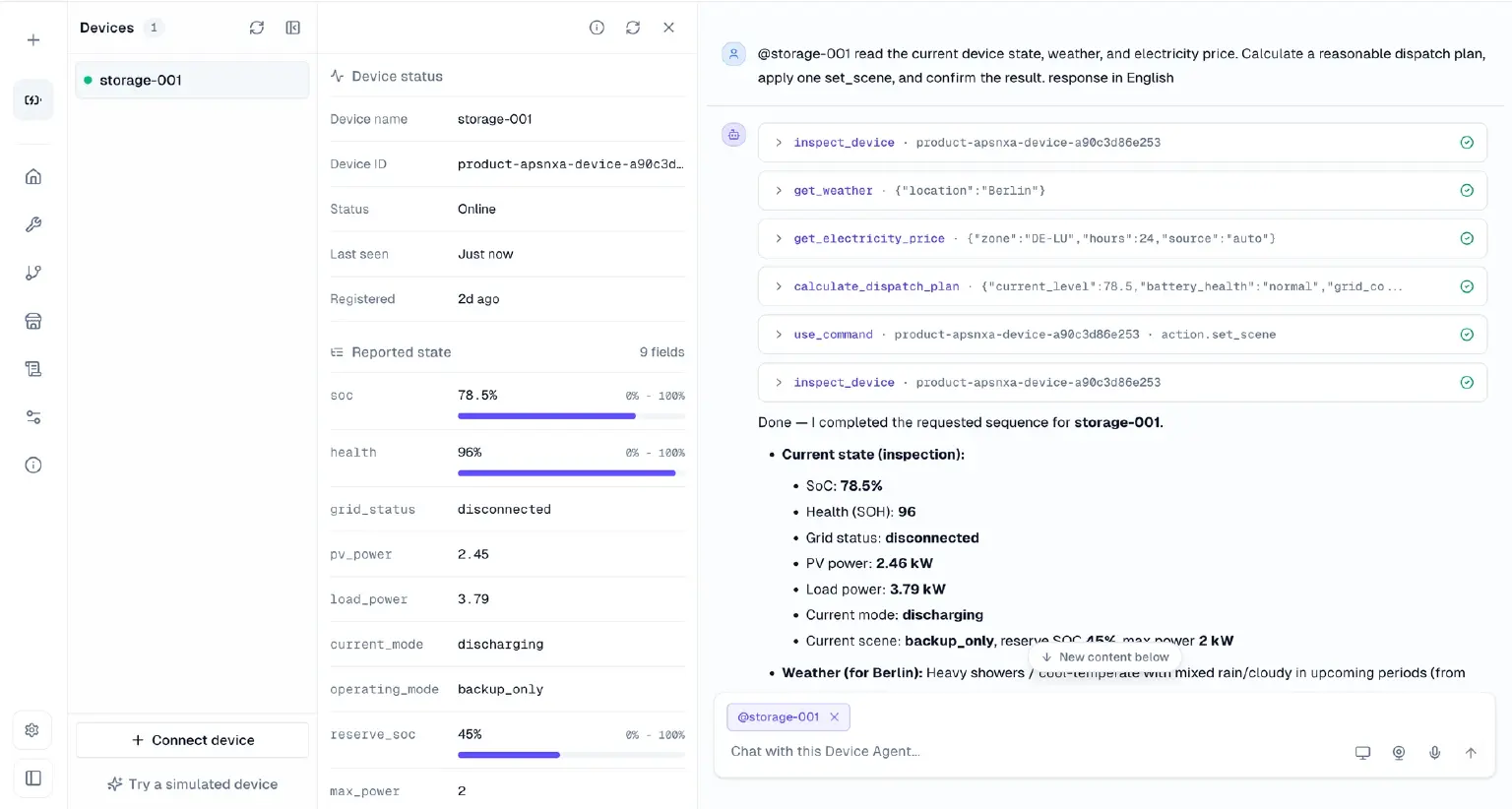
Device Agent equips developers with conversational agent generation tools. Developers can define device capabilities, telemetry schemas, and event triggers using natural language. The platform automatically generates edge-driver code and agent workflow definitions. Integrated debugging consoles allow real-time visual inspection of model reasoning, tool invocations, and command execution, compressing feature delivery timelines from weeks to days.
Enterprise Data Security & GDPR Compliance
Cloud-based energy management necessitates robust data protection. The EMQ Device Agent supports full private cloud or regional deployment within local boundaries (e.g., EU data centers). End-to-end payload encryption protects granular telemetry, while strict access controls ensure personal consumption patterns are isolated.
Furthermore, a tiered data abstraction strategy ensures raw personal behavioral metrics remain within secure user-authorized boundaries, outputting only anonymized control vectors down to edge devices in full compliance with GDPR and global privacy standards.
Architecture Summary: Traditional vs. Device Agent
| Dimension | Traditional Firmware Architecture | EMQ Device Agent Architecture |
|---|---|---|
| Interaction Model | Multi-step mobile app UI & static modes | Conversational Natural Language |
| Perception & Adaptation | Fixed parameters; manual reconfiguration | Dynamic hourly loops matching tariff & weather feeds |
| Release & Iteration | Firmware OTA releases (2–4 week cycles) | Cloud hot-swapping, instant skill updates, rollback anytime |
| Intelligence Mechanism | Hardcoded logic rules inside edge MCU | AI Agent reasoning with pluggable skill tools |
| Hardware BOM Impact | Requires costly high-performance edge chips | Lightweight MCU at edge; compute offloaded to cloud |
| Ecosystem Portability | Tightly coupled to proprietary vendor models | Unified device abstraction layer; cross-brand reuse |
The Future of Residential ESS: Drive Sustainable Growth with AI-Native Agility
As hardware differentiation diminishes in the residential energy storage market, AI-driven software agility and real-time user experience have become the primary growth driver.
By offloading complex AI reasoning from constrained edge hardware to the cloud, EMQ Device Agent transforms static home batteries into dynamic, autonomous energy hubs. This offers energy storage manufacturers the architectural foundation needed to outpace market changes, maximize consumer value, and lead the next wave of smart energy innovation.